
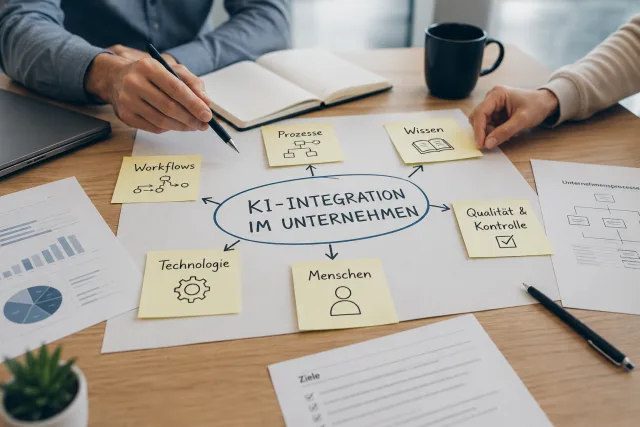
AI integration means permanently integrating artificial intelligence into existing business processes, knowledge sources and workflows. The aim of AI integration is not merely to use AI selectively as an individual tool. Instead, it should be used across the organisation in a controlled, repeatable and scalable way.
In many companies, however, the reality of AI integration still looks different. Employees use different chatbots, AI assistants or specialised tools. They develop their own prompts, upload documents manually and then transfer the results to other systems.
This enables quick initial successes. However, it does not create sustainable AI integration into business processes.
As soon as several employees, departments or locations work with AI, new challenges arise. Companies must clarify which knowledge the AI should take into account and which rules apply. The question also arises of how successful prompts can be reused and how terminology can remain consistent.
In addition, it is crucial to determine how results are reviewed. It must also be defined when human approval is required and how AI processes can be scaled over the long term.
This is precisely where ownvia® comes in. The platform combines powerful AI models with corporate knowledge, terminology, style guides, reference materials and reusable workflows.
The central approach is clear: not every employee starts with an empty chat window for every task. Instead, successful AI processes are structured, stored and made reusable for other users.
Why does AI integration often fail when it relies on individual tools?
An individual AI tool can be very powerful. Nevertheless, this does not automatically mean that it is integrated into a business process.
In practice, isolated workflows often arise. One employee uses an AI tool, formulates a prompt and receives a result. Another employee takes a different approach and uses another tool or different input.
This creates different approaches to identical tasks. As a result, outputs become inconsistent and quality levels vary. At the same time, prompts are developed multiple times and often remain with individual people.
In addition, corporate knowledge is often used inconsistently. Structured quality checks and clear approval processes are also frequently lacking.
Access to AI is therefore not the same as AI integration.
True AI integration begins where AI becomes part of a defined and repeatable process.
What does successful AI integration require?
For sustainable AI integration, several levels must work together. Four areas are particularly crucial.
1. Integrating corporate knowledge in a targeted way
Generic AI models do not automatically know a company. They know neither internal product names nor binding technical terms or style requirements.
It is therefore crucial to integrate relevant corporate knowledge in a targeted way. This includes, for example, glossaries, terminology, style guides, reference documents or internal policies.
What matters here is not the quantity of data. The right context for the respective task is what matters.
ownvia® makes it possible to integrate precisely this context into AI processes in a structured way. This means that information does not have to be reassembled for every request.
2. Turning prompts into reusable workflows
Individual prompting is a good starting point. However, it is not sufficient for scalable processes.
If a successful process depends on just one person, this knowledge remains isolated. Successful prompts must therefore be transformed into reusable workflows.
This is precisely where ownvia® comes in with Translation Templates. Prompts, terminology, style guides and references are combined into a fixed process.
This creates a process that does not merely work once, but can be used continuously.
3. Specialised AI applications instead of generic tools
Not every task should be solved through a general chat window. For recurring processes, specialised applications are significantly more efficient.
ownvia® uses a micro-app architecture for this purpose. Companies can provide targeted AI applications for specific tasks.
This reduces complexity. At the same time, quality increases because processes are clearly defined.
4. Integrating quality and human control
AI models deliver good results. Nevertheless, they work probabilistically and can make mistakes.
AI integration must therefore also take quality assurance into account. Results should be reviewed, assessed and adjusted where necessary.
ownvia® integrates structured post-editing processes for this purpose. Human expertise is used precisely where it is needed.
This creates a combination of efficiency and control.
What is the difference between using AI and true AI integration?
The difference is fundamental.
With isolated AI use, each employee works independently. Processes are not standardised and results vary.
With integrated AI use, on the other hand, workflows are defined. Knowledge is integrated and results are reproducible.
An AI tool provides answers. AI integration creates processes.
How does ownvia® implement AI integration in practice?
ownvia® was developed to integrate AI into business processes in a structured way.
The platform combines AI models with terminology, style guides, references and workflows. At the same time, it enables reusable processes and integrated quality assurance.
The crucial difference lies in orchestration. AI is not used in isolation, but is deliberately controlled and integrated into processes.
Why is the integration layer becoming increasingly important?
AI models are evolving rapidly. New models are emerging and existing ones are improving.
For companies, this means that the individual model is not the decisive factor.
More important is the layer that connects models with processes. This is precisely where long-term value is created.
Integration determines whether AI remains merely a tool or becomes a genuine part of value creation.
How can companies get started with AI integration?
The process should begin in a structured way.
First, a clear use case should be defined. The relevant data and knowledge sources must then be identified.
Based on this, processes are defined and quality requirements established. Finally, the workflow is made reusable.
This creates a scalable AI integration step by step.
Conclusion: AI integration begins where tools end
Individual AI tools deliver quick results. But they do not replace structured processes.
Sustainable AI integration only emerges when AI is connected with corporate knowledge, clear rules and reusable workflows.
This is precisely where ownvia® comes in.
The AI model generates a result. Integration is what turns it into a functioning business process.