
Skip to content
ownvia

Blog

Knowledge for better AI translation in business.

Articles on quality assurance, data protection, glossaries, post-editing and multilingual content.

Trados Studio and ownvia as a connected solution for AI translation

7 September 2026

Trados AI Plugin: Enterprise AI with ownvia directly in Trados Studio

AI translation directly in the Trados workflow The ownvia Trados AI Plugin connects Trados Studio directly to the Language AI platform ownvia. Companies and language service providers can use it to access generative AI, terminology, corporate knowledge and customised translation guidelines directly in existing Trados workflows – without having to leave their familiar CAT environment. Why is a Trados AI Plugin needed? Trados Studio is an essential part of professional translation processes for many companies […]

Read article
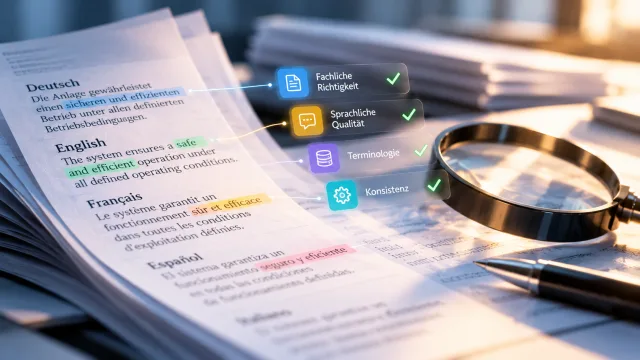
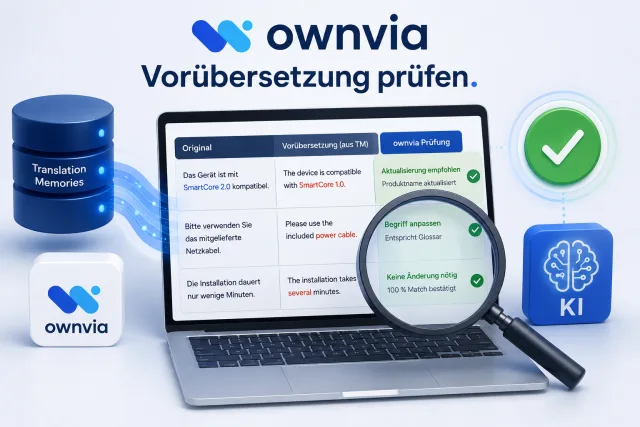
Illustration of an AI-supported pre-review of Translation Memories and pretranslations in ownvia. The AI analyses existing translations, identifies outdated terminology and supports quality assurance in professional translation processes.

17 July 2026

Reviewing Translation Memories with AI: How to Keep Pretranslations Up to Date

How can Translation Memories be evaluated with AI? Translation Memories have been among the most important tools in professional translation processes for many years. But this is also where a risk lies: the older a Translation Memory becomes, the greater the likelihood that outdated terminology, former product names or obsolete wording will repeatedly be carried over into new translations. Many companies […]

Read article
Product update from ownvia: AI assistant for professional translation prompts with analysis of websites, style guides, reference documents and terminology.

14 July 2026

Product update: July 2026

AI assistant for professional translation prompts The AI assistant supports companies in developing professional translation prompts. Simply describe your requirements – ownvia will turn them into a translation prompt tailored to your company. Many companies have had the same experience in recent months: Their first AI translations are convincing. Texts are created faster, quality is right and the possibilities offered by modern AI systems are impressive […]

Read article
Infographic comparing unstructured AI chatbots with an AI orchestration platform for businesses.

13 July 2026

Overcoming Prompt Fatigue

How a Swabian tech project is helping companies adopt controlled AI use Large language models are currently changing numerous office and knowledge processes. At the same time, many companies face the challenge of integrating these technologies sensibly into existing workflows. The Reutlingen-based consultancy SATRI Consulting is pursuing an approach with its platform ownvia that is designed to integrate AI systematically into business processes. Article […]

Read article
Strategic AI integration in the company: corporate knowledge, workflows, processes and quality assurance are connected to create scalable AI applications.

13 July 2026

AI integration: Why individual AI tools are not enough

AI integration in business processes: How can AI be integrated successfully? AI integration means permanently integrating artificial intelligence into existing business processes, knowledge sources and workflows. The aim of AI integration is not merely to use AI selectively as an individual tool. Instead, it should be used across the organisation in a controlled, repeatable and scalable way. In many companies, however, the reality of AI integration still looks different. Employees use different chatbots, AI assistants or specialised tools. They develop their own prompts, upload documents manually and then transfer the results to other systems. […]

Read article
Advance TMS with AI: Connect existing translation processes and language data with modern AI workflows

10 July 2026

Rethinking TMS: Advancing existing translation processes with AI

Many companies have invested significant resources in professional translation processes over the years and now face the question of how to advance their TMS with AI. Translation memories have been built, terminology databases maintained and XLIFF-based workflows established. This contains far more than translation assets. It contains valuable corporate knowledge: approved wording, specialist terms, product names, linguistic decisions and evolved process l...

Read article
LLM translation for businesses

7 July 2026

LLM translation for businesses

How does LLM translation differ from NMT and AI platforms? Businesses exploring LLM translation quickly face a fundamental question: Is a powerful language model sufficient for professional translation processes? At the same time, they encounter terms such as NMT, LLM and AI platform. These are often presented side by side, even though they describe different technologies and levels. NMT is a specialised technology for machine […]

Read article
Translate a website with AI and professionally localise multilingual content

6 July 2026

Translating a Website with AI: How Professional Website Localisation Works

Why should companies translate their website with AI? Having a website translated with AI enables companies to provide multilingual content faster and at greater scale. International websites need to do more than simply transfer texts into another language. Product terms, navigation, tone of voice, SEO content and recurring page elements must remain consistent across many pages. AI can significantly accelerate website translation […]

Read article
AI translators for businesses with terminology, GDPR-compliant processes and automated translation workflows

6 July 2026

AI Translators for Businesses: Technologies and Enterprise Platforms Compared

Why are AI translators important for businesses today? AI translators for businesses are becoming increasingly important because companies in the DACH region need to provide technical documentation, product information, marketing content and digital content in multiple languages. A single high-quality translation is often not sufficient for this. Professional B2B use requires specialist terminology, corporate language, data protection, quality assurance and recurring processes to be taken into account, w...

Read article