

Translation service providers often face the same decision: How can AI translation be integrated into existing workflows without blurring roles, review processes and responsibilities? The key is not solely the choice of an AI translator, but rather a process design that functions reliably from commissioning through to approval.
A suitable AI workflow for translation service providers clearly separates preparation, translation, review and client approval. In this article, we present a practical model, identify important interfaces and explain how companies can use ownvia to move step by step from a pilot project to productive use.
Why process design is more important than the individual AI translation
An AI can generate translated texts quickly. In a professional environment, however, terminology, style guidelines, company knowledge, data protection and project-specific requirements must also be taken into account.
Without a clear process, typical problems arise: requirements are passed on incompletely, specialist terms are used inconsistently or changes from the review are not fed back in a traceable manner. The question of who makes which decision then also remains open unnecessarily long.
A robust process should therefore answer at least the following questions before the project starts:
- Which content will be translated and what quality requirements must it meet?
- Which terminology, style guidelines and company information apply to the project?
- Which tasks are handled by the AI, which by the translation team and which by the client?
- When does the subject-matter review take place and who grants final approval?
- How are changes, exceptions and recurring insights documented?
A process model from commissioning through to approval
The following model does not completely replace existing translation processes. Instead, it structures the interfaces between project management, AI-assisted translation, professional review and client decision-making.
1. Qualify the assignment and document the requirements
The process begins by clarifying the assignment. In addition to the source and target languages, the content type, target audience, publication location, deadline and desired quality level should be recorded.
For an AI workflow in a translation agency, it is also important to establish whether the content consists of recurring material, technical documentation, marketing material or legally sensitive texts. This classification influences the review effort and the role of human processing.
At this stage, project management should already define which resources will be involved and which approval steps will be required. This turns a general translation assignment into a clearly defined process.
2. Prepare terminology and style guidelines
Before the actual translation begins, the available terminology, spelling conventions and project-specific requirements are reviewed. These include, for example, preferred product names, prohibited formulations, forms of address, or requirements for headings and user interfaces.
This information should not simply be stored as loose documents in the project folder. It must be accessible to the people involved and to the platform being used, and must be sufficiently clear so that translation and review are carried out on the same basis.
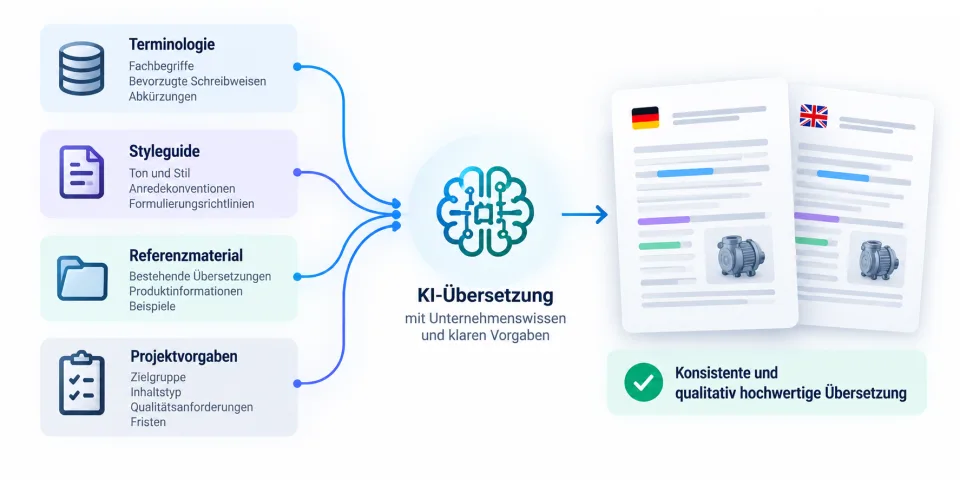
With ownvia, AI translation, terminology, style guidelines and company knowledge can be integrated into a professional translation workflow. This creates a shared basis for working, but does not replace the specialist assessment of difficult or ambiguous passages.
3. Check content and prepare it for processing
Before starting, the team should check the source files for completeness, placeholders, recurring text modules and special formatting requirements. Content that is not to be translated must also be clearly marked.
This preparation reduces rework and prevents formal errors from later being mistakenly treated as translation issues. For larger projects, it is worth defining recurring checks as an integral part of the workflow.
4. Use AI translation with clear guidelines
AI translation is the next step, but it should not be viewed as isolated automated output. Context, terminology and style guidelines must be incorporated into the processing so that the result suits the respective company and project.
Controlled processing is particularly important for larger volumes. The team should define which content can be prepared automatically, which texts require more intensive review and which content generally requires special approval.
ownvia combines generative AI with company knowledge and professional translation processes. This allows the platform to be used as part of an existing AI workflow for language service providers, while responsibilities remain with the LSP.
5. Separate post-editing and specialist review
Post-editing and review pursue different objectives. During post-editing, the translated text is revised linguistically, terminologically and substantively. The review then checks whether the result meets the agreed specialist and project-specific requirements.
In practice, both tasks can be carried out by different people. A clear separation is particularly useful when one translator creates or edits the text and a second subject-matter expert independently assesses its quality.
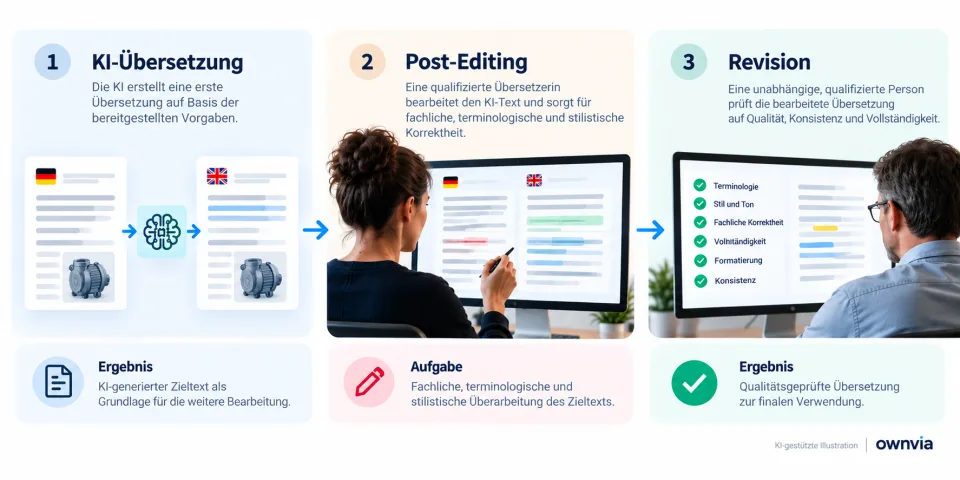
The post-editing process at the LSP should include at least the following checkpoints:
- Do the meaning, context and tone match the target audience?
- Are approved technical terms and product names used consistently?
- Are numbers, units, links, placeholders and formatting correct?
- Are there any cultural or legal considerations in the target market?
- Which changes should be recorded as future terminology or style guidelines?
6. Organise customer review and approval
The customer should not be presented with an unclear overall package only at the end. When the order is accepted, it must already be clear which subject-matter contacts will review the content and who will give final approval.
Ideally, a focused customer review includes specific review questions and a defined feedback channel. This makes it possible to distinguish requests for changes from fundamental requirements and avoid unnecessary correction cycles.
Project management consolidates the feedback, clarifies conflicting requirements and manages the final round of editing. Only then is the status changed to approved. Approval should be documented in a traceable manner, particularly for recurring or business-critical content.
Roles and responsibilities in the LSP workflow
AI-supported translation processes work better when each role has a clearly defined area of decision-making. The specific allocation of roles may vary from project to project, but responsibilities should never be unclear.
- Project management: qualifies the assignment, plans resources, coordinates schedules and manages escalations.
- Translation and post-editing: processes the target texts, checks meaning and language, and flags open questions.
- Subject-matter review: assesses terminology, technical accuracy, suitability for the target audience and compliance with the project requirements.
- Client or specialist department: provides specialist context, makes decisions in the event of conflicting content requirements and grants approval.
- Digitalisation or AI leads: monitor process quality, define standards and support gradual scaling.
These roles do not always have to be distributed among five different people. What matters is that, even in small teams, it remains clear who processes, who reviews and who makes binding decisions.
Integrating existing CAT tools and translation processes
Many companies and LSPs already work with translation memory systems, terminology databases, customer portals or their own project management solutions. A sensible AI workflow builds on this way of working instead of completely replacing it without sufficient reason.
An analysis of the existing process should therefore be carried out before implementation. Which steps work reliably today? Where do waiting times arise? At which handovers is information lost? And which quality checks must not be omitted under any circumstances?
The handovers between order capture, translation, review and approval are particularly relevant. They should be assigned clear status values, responsibilities and return criteria. This makes it clear whether a process is actually becoming more efficient or merely gaining additional control steps.
The right ownvia package for each use case
Which licence is suitable depends not only on the size of the company. The decisive factors are translation volume, the number of users involved, the regularity of projects and whether a limited pilot or a production rollout is planned initially. ownvia offers packages ranging from a controlled pilot to company-wide use with high volumes. You can find an overview on our pricing page.
Assessing quality, data protection and limitations objectively
AI translation is not a substitute for every form of professional review. Texts with high specialist, legal or brand-strategic relevance still require appropriate human oversight and clearly defined approvals.
Data protection and the handling of company information must also be reviewed before production use. This includes internal requirements, hosting and access rights requirements, as well as the question of which content may be processed at all.
A robust evaluation framework therefore considers more than just speed or cost. Consistency, traceability, correction effort, acceptance by specialist departments and the ability to operate the process in a controlled manner as volumes increase are equally important.
From pilot to production workflow in five steps
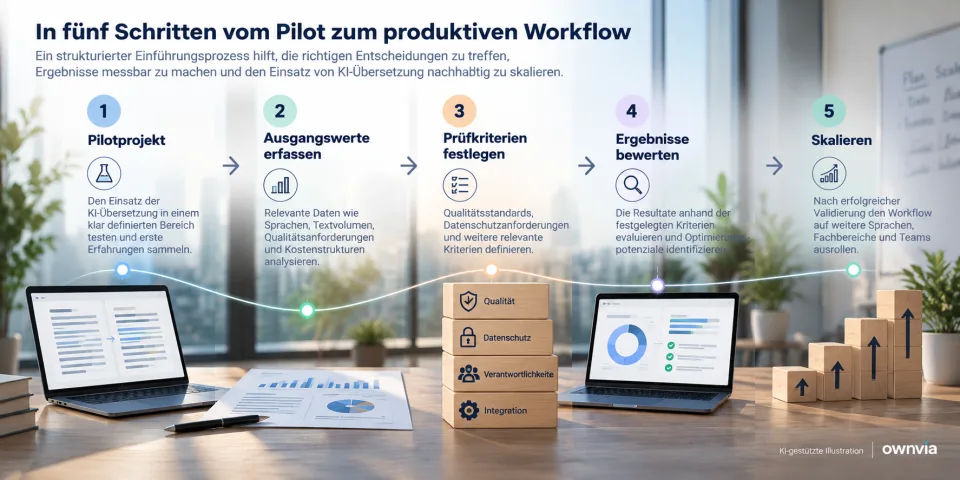
- Choose a suitable pilot segment: Start with a clearly defined content type and specified quality requirements.
- Document baseline values: Record processing time, correction cycles, frequent errors and current approval workflows.
- Define roles and review criteria: Assign responsibility for project management, post-editing, review and customer approval.
- Evaluate the results: Assess not only the translation result, but the entire process at the interfaces between teams and steps.
- Scale gradually: Only expand volumes and use cases once the process, quality assurance and responsibilities are working reliably.
This approach makes it clear whether the technology fits the operating model. It also prevents a single successful test from being prematurely interpreted as evidence for a company-wide rollout.
Assess your translation process now
Getting started with a professional AI translation workflow begins with analysing existing processes. Which steps can be automated effectively? Where do delays occur? And at which points is human expertise indispensable?
ownvia supports translation service providers in integrating AI-assisted translation, quality assurance and human editing into a structured production process.
Arrange a personal ownvia-demo to jointly assess how your existing translation processes can be supported and further developed with ownvia.