

Would you like to test AI translation, but not make a decision about production use based on individual sample sentences? A structured Translation AI pilot creates a reliable basis within 30 days: for selecting suitable content, assessing translation quality and deciding on the next step towards scaling.
The key factor is not to send as many documents as possible through a system. What matters is testing a realistic use case with suitable reference materials, clear metrics and a defined decision-making process.
What a good Translation AI pilot must achieve
A pilot project for AI translation should answer a specific business or operational question. This could include shorter turnaround times, less post-editing effort or more consistent use of specialist terminology.
The central question is not simply: "How good is the translation?" Rather, it is: "Under what conditions can AI translation be used in our professional workflow in a controlled and meaningful way?"
- Which content and language direction will be examined?
- Who will review the results, and according to which criteria?
- Which terminology, style guidelines and company information need to be taken into account?
- Which metrics will determine whether to continue, adapt or discontinue the pilot?
- Which licence and usage step makes sense if the results are positive?
The 30-day plan in four phases
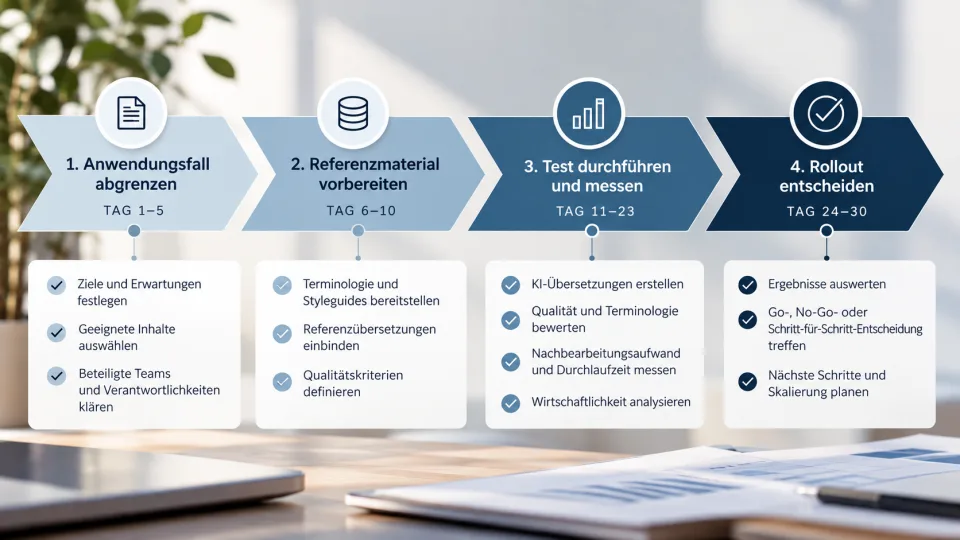
Phase 1: Define the use case
Days 1 to 5: Start with a clearly defined scenario rather than attempting to cover as broad a cross-section of all translation tasks as possible. The pilot should reflect a recurring process and contain enough material to make typical challenges visible.
For companies, this could be a defined document type from marketing, product management or technical documentation, for example. LSPs can select a representative customer or specialist department process, provided that the use and review of the content have been clarified.
At the outset, document the current situation. This includes processing times, typical correction loops, existing terminology lists and the people who approve translations.
Phase 2: Prepare reference material
Days 6 to 10: The quality of a pilot depends heavily on the quality of its source material. Therefore, compile texts that correspond to the later use case in terms of scope, subject matter and level of difficulty.
Also prepare the information the system needs to deliver consistent results. This includes terminology, style guidelines, approved translations and relevant company knowledge. At ownvia, these requirements can be incorporated into the professional translation process.
Suitable pilot content usually meets several of these criteria:
- It occurs regularly and has clear potential for reuse.
- Its subject-specific requirements are comprehensible to internal reviewers or the translators responsible.
- There is a sufficient basis for comparison, such as existing translations or agreed quality criteria.
- The content contains terminology, style requirements or recurring phrases that can be checked.
- Its processing has been approved from both data protection and organisational perspectives.
One-off texts without a basis for comparison, highly fragmented content or documents whose technical accuracy no one can reliably assess are less suitable. Highly sensitive content should also only be included if the necessary approvals and framework conditions are in place.
Phase 3: Conduct and measure the test
Days 11 to 23: Conduct the test according to a predefined procedure. Do not compare only individual sentences; instead, consider the complete process, from handing over the source texts to subject-matter approval.
For an informative AI translation pilot project, at least two perspectives should be brought together: the subject-matter assessment of the results and the operational assessment of the workflow. This makes it clear whether a good raw translation actually leads to a more efficient overall process.

These metrics provide a reliable basis:
- Post-editing effort: How much time do specialists or translators need to approve the results?
- Terminology consistency: Are mandatory technical terms used consistently and appropriately for the respective context?
- Turnaround time: How long does the process take from the source text to the approved translation?
- Approval rate: What proportion of the content can be approved without fundamental revision?
- Process stability: Does the workflow also work with different text lengths, topics and editors?
Cost-effectiveness: How do the total costs per approved translation develop compared with the previous process, including AI usage, post-editing and quality assurance?
Define how the results will be evaluated before the test. A simple scale with clear criteria may be sufficient, provided that all reviewers apply it consistently. Supplement the metrics with qualitative observations, such as recurring errors in technical terms, tone of voice or contextual understanding.
Phase 4: Decide on the rollout
Days 24 to 30: Summarise the results in a decision paper. Distinguish between findings, outstanding risks and specific requirements for scaling up.
A rollout may be appropriate if the pilot demonstrates a clear benefit, the quality requirements are met and responsibilities for review and approval have been established. A negative or inconclusive result is also valuable: it shows which content, specifications or process steps need to be adjusted before further evaluation.
Before making the decision, check in particular:
- Does the process achieve the previously defined quality and time targets?
- Are the results consistent across multiple documents and processors?
- Is it clearly defined which content is processed automatically and which content will continue to be fully reviewed?
- Are terminology, style guidelines and company knowledge sufficiently taken into account?
- Has approval been obtained for data protection, information security and organisational use?
- Can the process be integrated into existing translation and approval workflows?

Choosing a realistic pilot scope
A pilot should be representative without becoming unnecessarily complex. For a first professional introduction, the ownvia Enterprise 1K package with up to 1,000 activations per year is suitable. It provides access to the core functions of the ownvia platform and is suitable for smaller translation volumes, pilot projects and controlled testing.
The right size depends not only on the number of documents. Also consider language combinations, recurring processes, participating teams and the expected number of users.
From proof of concept to controlled scaling
If the pilot demonstrates a viable use case, scaling should take place gradually. The ownvia Enterprise 10K package is designed for regular productive translation requirements with up to 10,000 activations per year. It combines AI translation with terminology, style guidelines, company knowledge and professional translation workflows.
For larger translation volumes, the Enterprise 100K package with up to 100,000 activations per year is available. It supports organisation-wide use of the platform when multiple language departments, continuous translation processes or larger LSP structures are involved.
For particularly high volumes or specific conditions, Enterprise Custom may be the right option. The scope, activation volume and other conditions are tailored to the respective use case.
What the decision paper should include

A good template makes the decision transparent and comprehensible for management, the Translation Manager and other stakeholders. It should not merely show a test result, but establish the connection between the initial situation, the process and the recommended course of action.
- Initial situation: Which process and problem were investigated?
- Pilot design: Which content, language directions and reviewers were involved?
- Results: How did post-editing effort, terminology adherence, turnaround time, approval rate and total costs develop?
- Limitations: For which content or process steps did difficulties arise?
- Recommendation: Should the pilot be discontinued, adapted or transferred into productive use?
- Next steps: Which content, users, specifications and activation volume are required for the next phase?
Start with a clear next step
A translation AI pilot does not have to be either unwieldy or theoretical. With a defined use case, prepared reference material, measurable criteria and a planned decision phase, a solid basis for further use can be established in 30 days.
We would be happy to discuss with you, which process is suitable for a pilot, which content is useful and how we can ownvia support your individual translation needs.
Book a personal conversation with ownvia and assess your options for use without obligation.