
Transparency notice: ownvia is a product of SATRI Consulting. This article is intended for professional information only and does not constitute legal advice.
Generative AI gives the sentence a new meaning. Employees translate quotes, instructions and emails every day using ChatGPT and other AI tools. In doing so, they teach the AI how their company communicates: which technical terms apply, what tone is appropriate for the customer, and what a product is called. However, this knowledge usually remains in the personal chat history and does not become part of a shared knowledge base.
The answer in brief: Shadow AI in translation means that a company communicates differently in every department. Technical terms, corrections and successful formulations emerge in private AI chats and remain there. There are also questions around data protection and confidentiality. The solution is a shared environment in which terminology, approved translations and guidelines are maintained centrally and applied to every assignment.
How widespread is shadow AI in companies?
Shadow AI refers to the use of AI tools outside the applications provided or approved by a company. Two recent surveys show that it is part of everyday life in German companies.
Survey | Result |
|---|---|
Bitkom survey of companies, published in October 2025, 604 companies with 20 or more employees | In 8% of companies, the use of private AI tools is widespread; in a further 17%, there are isolated cases, while another 17% suspect such use without knowing for certain. |
Employee survey by the Institut der deutschen Wirtschaft, March/April 2026, just under 5,000 employees | 29.1% of employees who use AI for work also use tools that their employer has not provided. |
Taken together, 42% of the companies surveyed by Bitkom therefore report or suspect shadow AI. “Not provided” does not automatically mean “prohibited”. However, it shows that actual AI use and official processes are out of step.
One finding from the IW is surprising: shadow AI is most common where employers promote the development of AI skills – 44.5% of employees who receive strong support use tools that have not been provided, compared with 21.3% where no support is perceived. The IW describes this as a provision gap: employees’ willingness is growing faster than the official offering. According to Bitkom, only 26% of companies currently provide their employees with generative AI. Shadow AI is therefore less a sign of rule-breaking than a sign of unmet demand.
This is particularly serious when it comes to translations. Unlike a short search query, the complete document is usually submitted to the AI – including specialist knowledge, customer data and product details.
What employees teach AI every day
Anyone who translates with AI enters more than just text. Good results are only achieved when employees explain to the AI how their company communicates. “Teaching” here refers to instructions and context in the respective chat, not to training the AI model. Typical instructions from day-to-day work include:
- Terminology: "We call the component the drive unit, not the motor module."
- Tone of voice: "We address customers in Sweden by their first names."
- Product knowledge: Explanations of technical relationships to ensure the translation is technically accurate.
- Corrections: "This sounds too promotional; please make it more factual."
- Context: uploaded previous versions, reference documents and earlier translations.
This is exactly the knowledge that companies otherwise maintain at considerable effort in terminology databases, style guides and Translation Memories. Employees create it incidentally, every day and often to a high standard. The problem is that it is never stored centrally.

Practical example: One component, three translations
A medium-sized mechanical engineering company uses AI for translation in three departments. Sales translates quotations, Service translates maintenance instructions, and Technical Documentation translates operating manuals. Each department uses its own accounts and prompts.
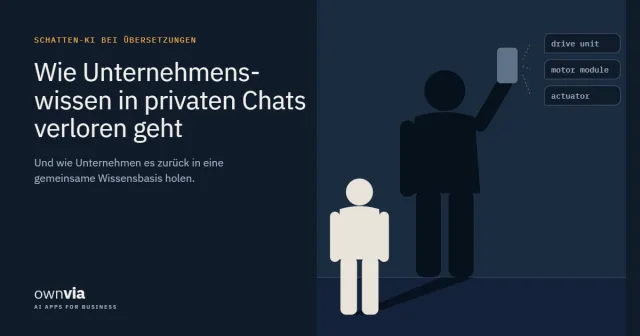
The result: The same component appears in English as "drive unit", "motor module" and "actuator". The customer receives a quotation, a manual and a service note with three different terms for the same part. Each department taught its AI something correct—but each taught it something different.
The one-way street: Knowledge flows out, but not back in
Shadow AI works like a one-way street: corporate knowledge flows into private AI chats, but not back into the company. Employees add technical terms, correct wording and provide reference documents. This improves their own results. But without a shared process, this knowledge does not become part of a centrally maintained knowledge base – what is corrected in a personal chat today is not available to a colleague for their next assignment. The consequences are evident in everyday work:
What gets lost | Impact on everyday work |
|---|---|
Corrections and technical terms | Anyone who defines a technical term in their chat defines it only for themselves. Colleagues use different terms or clarify the same question again. |
Approved translations | Similar texts are repeatedly translated and checked from scratch instead of reusing proven wording. |
Consistent terminology | The same thing is called different things depending on the department – when dealing with customers, authorities and partners. |
Institutional knowledge | When someone leaves the company, the language knowledge they built up over months disappears with their account. |
Traceability | No one can say which document version was translated with which specifications and who checked it. |
The paradox is that language knowledge is being documented more comprehensively than ever before today – term by term, correction by correction. It is simply happening in a place the company has no access to.
And data protection? The other side of the same coin
The same one-way street has a second side: Along with the knowledge, data also leave the company. If a document contains personal data, the GDPR applies. If an external service is used as a processor, a contract under Article 28 GDPR is generally required. Business secrets and confidentiality obligations towards customers also apply, regardless of whether personal data are involved.
Personal AI accounts are therefore generally not a suitable solution for confidential or personal company documents. Business offerings provide more control: OpenAI, for example, does not use data from ChatGPT Business and Enterprise for model training by default and provides a data processing addendum (OpenAI Enterprise Privacy). But even then, the following applies:
Important: “No model training”, “no storage” and “processing exclusively in the EU” are three different statements. In ChatGPT Business, for example, the selected region controls where content is stored – not necessarily every processing step (OpenAI: Storage location in ChatGPT Business).
A data processing agreement is an important prerequisite, but not complete proof. The legal basis, data minimisation, transfers to third countries and, where applicable, a data protection impact assessment remain the company’s responsibility. We explain in detail how companies can establish the rules for this in our article AI translation in companies: Governance in four steps.
Reclaiming knowledge in five steps
Shadow AI emerges because private chat is faster and more convenient than the official route. Bans alone achieve little: According to IW, they would primarily affect committed employees. More effective is an official route that works better than private chat.
- Make usage visible – without blanket suspicion. Ask which departments are using AI to translate, which texts, languages and volumes are involved, and which prompts have proven effective. The aim is understanding, not control.
- Gather existing language knowledge. Glossaries, proven instructions, approved translations and style guides are often already scattered across departments. They form the foundation for a shared basis.
- Provide an approved environment that convinces. It must be at least as easy to use as the private chat and offer more: better results because the company’s knowledge is already built in.
- Maintain knowledge centrally and apply it purposefully. Terminology, Translation Memories and specifications are maintained once and assigned to the relevant task. Approved corrections and translations can be incorporated into the shared knowledge base and reused for future tasks. This gradually turns a one-way street into a cycle.
- Regulate review, approval and AI competence. Define which texts require subject-matter review and who grants approval, and provide employees with practical training. This also supports the obligation under Article 4 AI Act to take measures to promote AI literacy.
How ownvia retains language knowledge within the company
ownvia is the AI infrastructure for professional translation processes. The central idea: your language and your knowledge remain the constant, while the technology continues to evolve with ownvia. Instead of getting lost in private chats, language knowledge grows in one place that all authorised users can access.
Storing knowledge is not the same as applying knowledge in the right context. A central knowledge base alone is not enough. A task involving machine control requires different specialist terms and reference texts from a marketing brochure. That is why the relevant company knowledge must be assigned specifically to the respective task. Only then can the AI take the appropriate information into account without being burdened by contradictory or irrelevant specifications. That is precisely what Translation Templates in ownvia are for.

The problem of shadow AI | The answer in ownvia |
|---|---|
Technical terms are explained anew again and again | Terminology is maintained centrally and taken into account for the assignments to which it is assigned. |
Approved translations remain unused | Translation Memories make proven formulations reusable. |
Instructions are embedded in individual prompts | Translation Templates bundle style guides, reference knowledge and instructions for recurring tasks. |
Product and specialist knowledge is scattered | Company knowledge and document context are deliberately incorporated into the translation. |
Review depends on chance | A Translate Agent translates, a separate QA Agent checks and provides suggestions without changing the text itself. In ownEDITOR, people review and approve (human-in-the-loop). |
The private chat is more convenient | The Translation Chat offers the familiar chat format – with the company’s knowledge in the background. |
Standalone solutions alongside existing tools | The ownvia AI Translation Provider integrates the platform into Trados Studio, with an API and XLIFF also available. |
The difference from a general chat assistant does not lie in the fact that it could not process glossaries or style guides. What matters is whether the knowledge is maintained centrally, applied consistently for every assignment and linked to defined checking steps. In 2026, ownvia was included in the Slator list “Language AI 50 Under 50”.
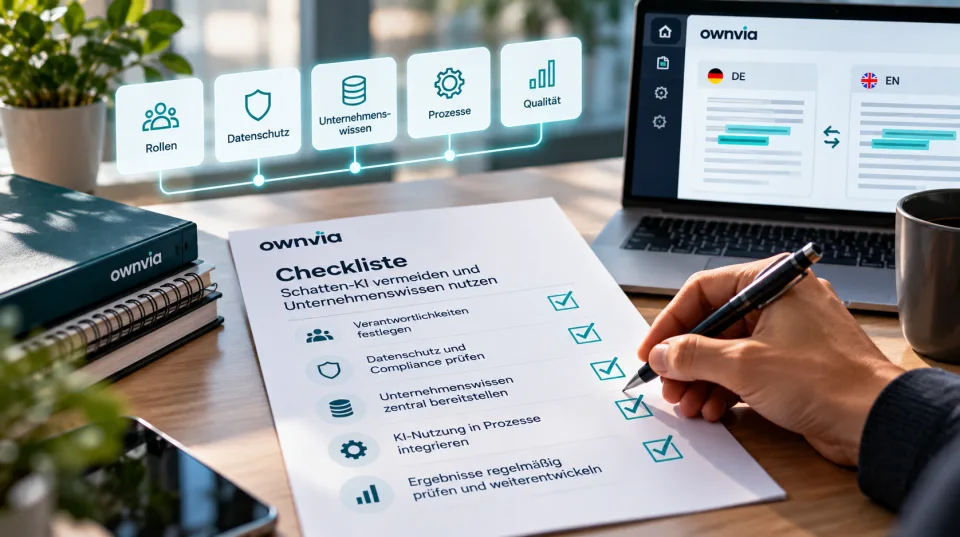
Checklist: Does your language knowledge stay within the company?
- We know which AI tools employees use for translations.
- Proven instructions and glossaries from the departments have been collected.
- Mandatory terminology is maintained centrally and applied automatically.
- Approved translations are systematically reused.
- There is a defined process for incorporating checked and approved corrections into the shared knowledge base.
- It is regulated which documents may be processed with which applications.
- Contractual and data protection requirements have been reviewed.
- Checking and approval steps for quality-critical texts have been defined, and employees have been trained.
The more points remain unresolved, the more language knowledge your company develops every day — and loses again. The checklist is intended as a guide and does not replace a data protection or legal review.
Conclusion: Shadow AI is a signal, not an enemy
The fact that employees translate with AI is initially good news. It shows demand, initiative and a wealth of language knowledge that is newly created every day. The problem is not the use itself, but that this knowledge ends up in private chats and data leaves the company without control.
Bringing terminology, guidelines and approved translations together in one place reduces data protection risks and creates a corporate language that improves with every reviewed translation.
The crucial question is therefore not: “Are our employees allowed to translate with AI?” But rather: “How do we ensure that what they teach the AI benefits the entire company?”
Talk to us about your translation process – we will show you ownvia in a demo.
Frequently asked questions about shadow AI in translation
What is shadow AI in translation?
Shadow AI refers to the use of AI tools outside the applications provided or approved by the company. In translation, this typically means translating business documents through personal ChatGPT accounts or other private AI services.
Why is language knowledge lost through shadow AI?
When translating, employees teach the AI specialist terminology, tone of voice and product knowledge. Without a shared process, this knowledge does not become part of a centrally maintained knowledge base. Colleagues cannot use it, the company cannot maintain it, and it is lost when employees leave.
Should companies prohibit private AI use?
A ban alone rarely solves the problem because the need remains. The Institut der deutschen Wirtschaft concludes that outright bans would primarily affect committed employees. A more effective approach is an approved solution that is at least as easy to use as a private chat and delivers better results through built-in corporate knowledge.
Is ChatGPT GDPR-compliant for translation?
There is no blanket answer. Business offerings with a data processing agreement and model training disabled create important prerequisites. Personal accounts are generally not suitable for confidential or personal data-containing company documents.
Is it enough to disable training with my data?
No. Disabling this only affects use for model training. Questions concerning the legal basis, confidentiality, storage location and access remain – as does the knowledge problem.
How can terminology remain consistent in AI translation?
By maintaining specialist terms centrally and assigning them to the relevant translation job, rather than explaining them in individual prompts. Translation Memories also ensure that approved wording is reused.
What does the AI Act require for AI translations?
Article 4 of the AI Act requires companies to take measures to promote the AI literacy of their employees. Since the amendment introduced by Regulation (EU) 2026/1744 of 27 July 2026, they are no longer required to guarantee a specific level of competence. Practical training on the opportunities and limitations of AI translations is a sensible component.