
AI translation can help companies process growing translation volumes more efficiently. However, successful implementation does not begin with selecting an AI model, but with clear rules for quality, data protection, responsibilities and professional translation processes.
Companies wishing to introduce AI translation should therefore first define the organisational framework. Which content may be processed? When is specialist review required? Who is responsible for terminology, approvals and selecting suitable use cases?
Why do companies need governance for AI translation?
Governance for AI translation refers to the organisational and technical rules companies use to manage data protection, translation quality, responsibilities and approval processes. The aim is to integrate AI translations into existing business processes securely, transparently and in accordance with consistent quality standards.
General-purpose AI tools often deliver translations that are easy to understand quickly. However, this alone is not sufficient for professional corporate communication, because translations in many areas must take binding terminology, sensitive information and specific quality requirements into account.
Governance for AI translation defines how decisions are made and processes are controlled. It therefore creates a robust link between technological possibilities and the requirements of specialist departments, language managers, data protection and quality management.
Such a framework is particularly relevant when several departments, languages or external translation service providers are involved. Without common guidelines, different working methods, inconsistent terminology and unclear responsibilities can quickly arise.
The four steps at a glance
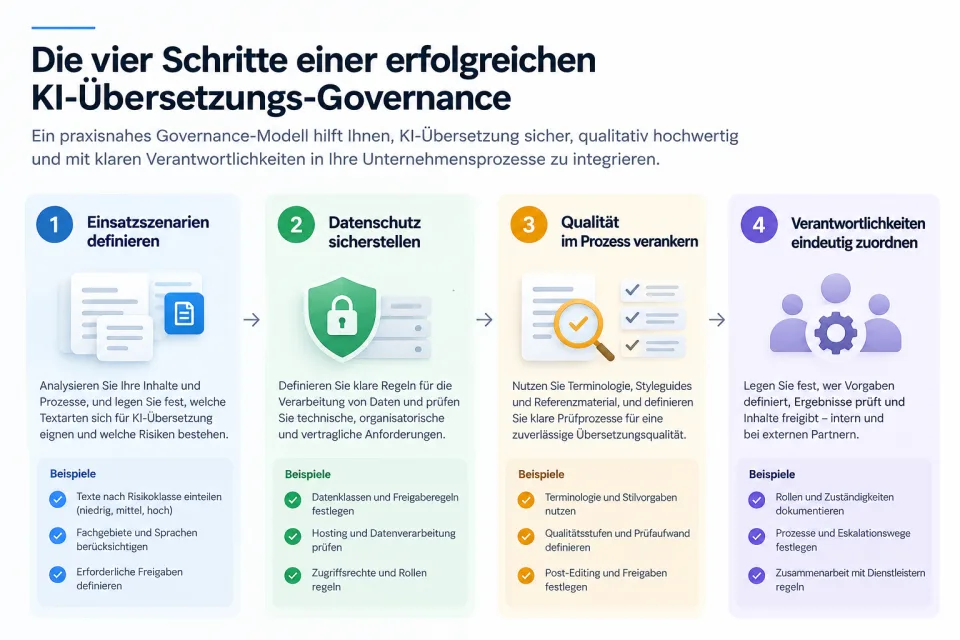
A suitable model does not have to be complicated. To get started, we recommend considering four steps together: use cases, data protection, quality and responsibilities.
- Use cases: Which types of text and processes are suitable for AI translation?
- Data protection: Which information may be processed and under what conditions?
- Quality: What requirements apply to terminology, style, subject-matter expertise and review?
- Responsibilities: Who defines guidelines, checks results and approves content?
These four steps should not be considered in isolation. A decision to use AI translation is always also a decision about data flows, review processes and how subject-matter responsibility is handled.
1. Systematically determine suitable areas of application
The first step is to structure the translation requirements. Not every text has the same significance, risk class or review effort. An internal work instruction can be handled differently from safety-relevant product documentation or a legally binding contract.
For the assessment, companies can, for example, classify their content according to confidentiality, technical complexity, target audience and required approval. This can be used to derive graduated rules for the use of AI translation.
- Low risk: internal drafts, working aids or content for initial guidance
- Medium risk: marketing, product or support content with technical and stylistic requirements
- High risk: legal, regulatory, security-relevant or particularly confidential content
This classification is not an automatic quality assessment. It serves as a basis for determining whether a translation can be used directly, requires post-editing or must be reviewed by qualified personnel.
Questions for selecting use cases
- Which types of text regularly generate a high translation workload?
- Which content contains confidential, personal or business-critical information?
- For which languages and subject areas are reliable terminologies available?
- Which texts necessarily require human review or approval?
- How is it documented which process was used to translate a text?
2. Do not address data protection retrospectively
Data protection should be addressed at the outset of the implementation. Companies should understand which data is processed, where processing takes place, which technical and organisational measures apply and which contractual frameworks need to be reviewed.
For confidential content in particular, it is crucial to know whether data is used to train models, how access is regulated and which storage or deletion policies are in place. The separation of tenants, roles and projects may also be relevant for companies and translation service providers.
A robust governance model therefore defines clear data classes and approval rules. Employees should not have to decide for themselves whether a document is suitable for a particular AI system without clear guidelines and appropriate tools.
The following questions, among others, can help assess a platform:
- In which region are content processed and hosted?
- What information is stored and how long does it remain available?
- Who can access projects, translations and reference materials?
- Are inputs or results used for other users or training purposes?
- Which evidence and agreements are available for internal review?
For many companies, EU hosting is an important part of the assessment. It does not replace a complete data protection review, but in conjunction with suitable processes and contractual arrangements, it can fulfil a relevant requirement.
3. Defining quality as a process
Quality in AI translation means more than a linguistically fluent target text. What matters is whether technical terms are used correctly, company requirements are followed and the content has been appropriately reviewed for its intended purpose.
Terminology and style guidelines should therefore not be considered only after translation. They are part of the translation process and must be accessible and usable for the teams responsible in each case.
Reference material can also improve consistency. Previous translations, approved wording, style guides and company-specific knowledge help align results more closely with the actual communication context.
Quality levels and post-editing
Not every translation requires the same level of processing. Companies can therefore define different quality levels, such as a quick overview, internal use or a publication-ready version with specialist review.
Post-editing remains an important part of professional translation processes. Subject-matter experts review the target text, correct relevant deviations and approve it depending on the content and risk. AI can support this process, but does not automatically replace professional responsibility.
For each quality level, at least the following points should be defined:
- required level of linguistic and subject-matter review
- binding terminology and terms not to be translated
- relevant style and formatting requirements
- how to handle uncertainties, errors and missing context
- documentation of review and approval
4. Clearly assign responsibilities
One of the most common implementation barriers is the unclear distribution of tasks. If no one is responsible for terminology, data protection, quality criteria and approvals, AI translation either remains uncontrolled or is not used productively despite the technology being available.
A simple role structure provides clarity. The specific designations may vary depending on the organisation, but the responsibilities should be documented clearly.
- Process owners: define objectives, use cases and escalation paths
- Language owners: maintain terminology, style guides and language quality requirements
- Subject-matter owners: review content from their respective areas of expertise
- Data protection and IT: assess data flows, access models and technical framework conditions
- Approval owners: decide whether results may be used internally or externally
When working with translation service providers, it should also be defined which responsibilities lie with the provider. These may include access to terminology and reference materials, carrying out post-editing and communicating in the event of technical ambiguities.
Integrating governance into the translation workflow
Rules alone do not yet lead to controlled results. They must be practical to implement in daily workflows. Ideally, the platform used should support the requirements directly through project settings, terminology, individual instructions and defined review steps.
For companies, this means that AI translation should not exist as an isolated step alongside existing processes. It should be embedded into the process of requesting, translating, reviewing, approving and publishing content.
A possible standard process comprises:
- Determine the content and risk class
- Select suitable terminology, references and style guidelines
- Create the translation using the defined settings
- Review and revise the result depending on the quality level
- Document approval and process the content further in the designated system
- Use experience and corrections to further improve the process
ownvia connects AI translation with terminology management, individual translation requirements, reference knowledge and professional translation workflows. This enables companies to align their governance requirements more closely with the actual translation process instead of documenting them exclusively in separate policies.
Start with a controlled pilot project
A pilot project is often the most sensible way to introduce AI translation within a company. The aim should not be to test as many use cases as possible at the same time, but rather a manageable process with clear success criteria.
Suitable examples include recurring content with sufficient volume, existing terminology and an accessible subject-matter team for review. At the same time, the pilot should demonstrate how data protection, quality and responsibilities will work in regular operations later on.
Before starting, companies should define:
- which process and which languages are being considered
- which content is excluded
- which quality level should be achieved
- who reviews and approves translations
- how terminology and reference knowledge are provided
- which results are evaluated after the pilot
The evaluation should not be based solely on speed or translation volume. Consistency, post-editing effort, acceptance by specialist departments, transparency of responsibilities and the practical feasibility of data protection requirements are equally important.
How companies can identify a suitable solution
A platform for professional AI translation should fit the organisation’s structure and existing translation process. What matters is not only which model is used behind the scenes, but also how well requirements, knowledge, reviews and responsibilities can be mapped.
When making their selection, companies can compare the following criteria in particular:
- support for terminology and mandatory language guidelines
- integration of company knowledge, reference material and style guides
- management of individual translation requirements and prompts
- suitable functions for post-editing and quality control
- roles, access rights and traceable workflows
- data protection, hosting and contractual framework conditions
- scalability for different teams, languages and translation volumes
- integration with existing professional translation processes
The licensing model should also match the planned use. For a limited pilot project, an entry package such as Enterprise 1K may be suitable, while regular productive use can be planned with Enterprise 10K or higher activation volumes. For particularly large or individual requirements, the scope can be considered within Enterprise Custom to suit the application scenario.
Conclusion: Introduce AI translation in a controlled, step-by-step manner
Introducing AI translation in a company does not mean abandoning existing quality and responsibility structures. It means integrating technology into professional processes in such a way that people, data, terminology and approvals work together effectively.
A practical governance model provides the necessary guidance. Companies should start with clearly defined use cases, review data protection at an early stage, define quality levels and assign responsibilities in a binding manner.
We would be happy to discuss how such an approach fits into your translation process. In a personal ownvia demo or an informal initial consultation, we can look at your use cases, requirements and possible next steps together.