Why are AI translators important for businesses today?
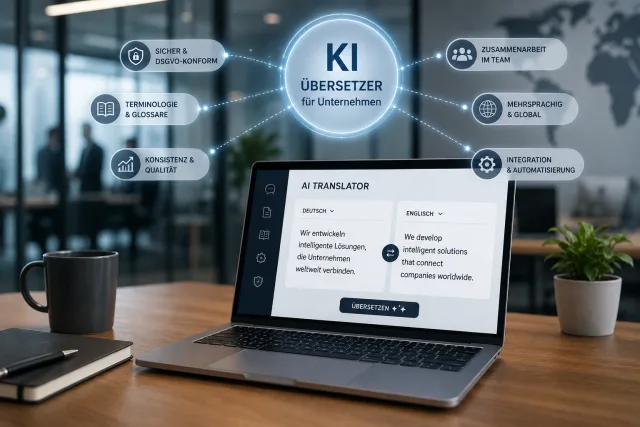
AI translators for businesses are becoming increasingly important because companies in the DACH region need to provide technical documentation, product information, marketing content and digital content in multiple languages. A single high-quality translation is often not sufficient for this.
Professional B2B use requires specialist terminology, corporate language, data protection, quality assurance and recurring processes to be taken into account. Enterprise platforms such as ownvia® address precisely these requirements: they combine AI-powered translation with company knowledge, terminology, style guides, post-editing and controlled workflows.
The central challenge of professional AI translation is therefore not just language. It is also a matter of knowledge, quality and processes.
Why are conventional AI translators often not sufficient for businesses?
Online translators and standalone AI tools can translate texts quickly and to a high linguistic standard. However, additional requirements arise in business use.
Depending on the solution, challenges may arise with:
- consistent specialist terminology
- binding product names
- corporate language and style guides
- review and approval processes
- reusing approved translations
- integration into existing processes
- data protection and governance
Businesses therefore often need more than a pure translation function.
Enterprise AI translation combines language quality with company knowledge and controllable processes. Platforms such as ownvia® make it possible to integrate glossaries, style guides, translation memories, reference knowledge and quality assurance into reusable translation processes.
What is an AI translator for businesses?
Definition: An AI translator for businesses is a software solution that automatically translates business content while being able to take company-specific requirements and sources of knowledge into account.
These include, for example:
- glossaries and specialist terminology
- style guides and corporate language
- translation memories
- reference documents
- quality rules
- review and approval processes
Different technological approaches can be used. These include, in particular, neural machine translation and large language models.
In an enterprise context, the focus is primarily on consistency, reusing existing knowledge, integration into existing processes, data protection and scalable collaboration.
ownvia® follows this type of enterprise approach: The platform combines AI models with company knowledge and reusable translation processes.
Which technologies are used for AI translation?
For businesses, NMT and LLMs are particularly relevant. Both can be used for translation, but they differ in their technological orientation and typical strengths.
Neural machine translation (NMT) is a specialised technology for machine translation. It is particularly suitable for fast, scalable and standardised translation processes.
Large language models (LLMs) are versatile language models. In addition to translation, they can take context, tone of voice, target audiences and additional linguistic instructions into account.
An enterprise platform, on the other hand, is not a third AI technology. It combines suitable AI models with company knowledge, terminology, style guides, translation memories, quality assurance and controlled processes.
ownvia® follows this type of orchestrating platform approach: Depending on the content, language and process, different AI models can be connected with company knowledge and quality mechanisms.
Anyone who wants to understand the differences in more detail can find a comprehensive classification in the article 🔗 “NMT, LLM and Enterprise Platforms: What Are the Differences in AI Translation?”.
Why is terminology crucial for AI translation?
A powerful AI model can translate a term correctly from a linguistic perspective and still produce a result that is undesirable from the company's perspective.
Example: A company is required to use the term “Service Portal”. Depending on the context, an AI could generate different variants:
- customer portal
- service area
- support portal
- service portal
All variants may be linguistically plausible. Nevertheless, they create inconsistency in corporate communications.
A central glossary can therefore define preferred terms, binding translations, product names and unwanted variants.
Businesses that do not yet have a central terminology base can identify relevant specialist terms using 🔗 AI-powered terminology extraction from existing documents, websites or translation memories and prepare them in a structured way.
In ownvia®, terminology can be integrated into translation processes and combined with style guides, translation memories and reference materials.
The more AI translation is scaled, the more important controlled terminology management becomes.
What is the difference between an AI tool and an enterprise platform?
A single AI tool can generate powerful translations. An enterprise platform also considers how company knowledge, quality and processes can be organised and reused on a permanent basis.
| Requirement | Single AI tool | Enterprise platform such as ownvia® |
| Yes | Yes | |
| Company-wide terminology | Depending on the solution | Can be integrated centrally |
| Style guides | Depending on the solution | Usable in workflows |
| Translation memories | Depending on the solution | Integrable |
| Reference knowledge | Depending on the solution | Can be used systematically |
| Quality assurance | Depending on the solution | Can be integrated into workflows |
| Post-editing | Depending on the solution | Integrated process |
| Roles and permissions | Varies | Can be managed centrally |
| Reusable workflows | Partially | Platform-based |
The specific range of functions always depends on the particular solution and configuration. The central difference therefore lies less in an individual feature than in the overall approach:
Is only a translation being generated, or is a reusable business process being established?
What is ownvia® in the context of AI translation?
ownvia® is an AI platform for businesses that combines translation with company knowledge and controlled workflows.
The focus is on combining:
- AI-powered translation
- terminology and glossaries
- style guides
- translation memories
- reference knowledge
- quality assurance
- post-editing
- reusable AI workflows
This means that AI is not used in isolation. Company knowledge can be integrated into recurring processes in a structured way.
ownvia® follows an orchestrating approach: different AI models, knowledge sources and quality mechanisms can work together depending on the particular use case.
For example, technical documentation, product information or marketing content can be processed with different requirements regarding terminology, style and quality.
Which businesses is ownvia® suitable for?
ownvia® is particularly relevant when several requirements come together:
- Translation volume: Content is regularly translated into several languages.
- Specialist language: Product names and industry-specific terms must remain consistent.
- Recurring content: Existing translations and company knowledge should be reused.
- Collaboration: Internal teams, specialist departments or external language service providers work together.
- Quality: Translations require review, post-editing or defined approval processes.
- Governance: Data protection, roles and controllable processes are relevant.
A specific use case is the multilingual provision of digital content. The article 🔗 “Translating a Website with AI: How Professional Website Localisation Works” shows how websites can be translated and localised systematically with AI.
The greater the requirements for consistency, control and reusability, the more important a central platform approach becomes.
Conclusion: What makes modern AI translation successful?
The decisive factor is not the language model used alone.
Professional AI translation is created by combining:
- suitable AI technology
- terminology
- company knowledge
- quality control
- human review
- reusable workflows
NMT and LLMs have different strengths. For businesses, the greatest benefit therefore often lies not in choosing a single model, but in the controlled combination of technology, knowledge and processes.
ownvia® addresses precisely this point: as an enterprise platform that combines AI-powered translation with company knowledge, quality assurance and reusable workflows.
FAQ: Frequently asked questions about AI translators for businesses
What is an AI translator for businesses?
An AI translator for businesses is a software solution for the automated translation of business content. Enterprise platforms such as ownvia® can also integrate terminology, style guides, translation memories, reference knowledge and quality processes.
Is a free online translator sufficient for businesses?
That depends on the use case. Simple tools may be sufficient for individual, non-critical translations. Binding specialist terminology, sensitive data, multiple target languages or controlled approval processes create additional requirements.
What is the difference between NMT and LLM?
NMT is a specialised technology for machine translation. LLMs are versatile language models that can also take context, tone of voice and complex linguistic instructions into account.
What is the difference between an AI tool and an enterprise platform?
An AI tool often focuses on a specific task. An enterprise platform combines AI models with company knowledge, terminology, quality processes and reusable workflows.
Why is terminology management important?
Terminology management helps ensure that specialist terms, product names and preferred translations are used consistently. In ownvia® terminology can be connected with other sources of knowledge and translation processes.
When is ownvia® worthwhile?
ownvia® is particularly suitable for businesses that want to provide multilingual content regularly, consistently and in a controlled manner while taking terminology, company knowledge, quality assurance and reusable workflows into account.