AI assistant for professional translation prompts
The AI assistant supports companies in developing professional translation prompts
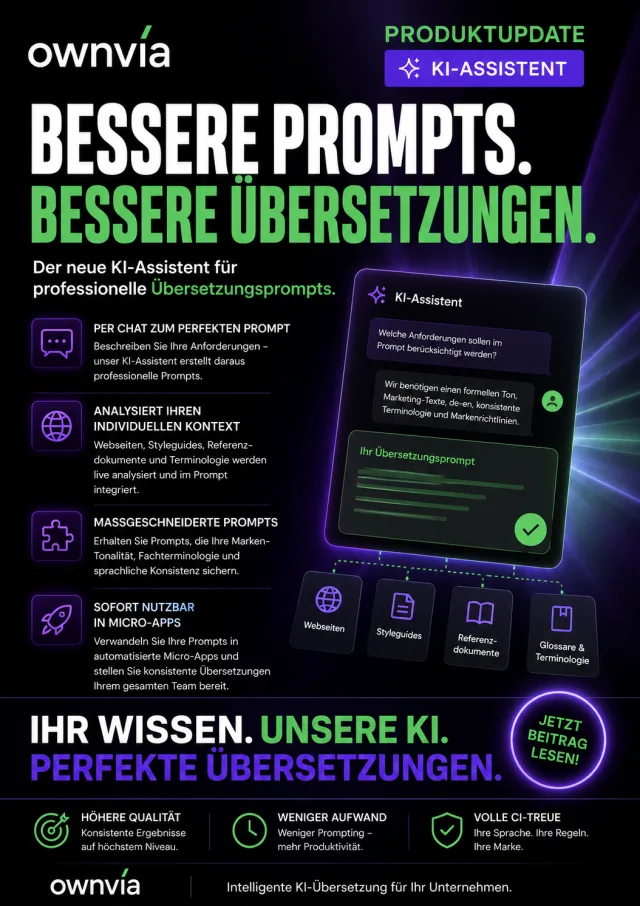
Simply describe your requirements – ownvia will turn them into a translation prompt tailored to your company.
Many companies have had the same experience in recent months: Their first AI translations are convincing. Texts are created faster, quality is right and the possibilities offered by modern AI systems are impressive.
However, increased use reveals a new challenge.
More and more employees are using AI for translations. Everyone develops their own prompts, describes requirements slightly differently or sets individual priorities. Although everyone works with the same AI technologies, the results vary.
Technical terms are used inconsistently, the tone of voice changes and the company’s language is increasingly losing its consistency.
The real problem is therefore no longer the translation itself. It is the lack of standardisation.
Many companies have been investing in terminology, style guides and consistent corporate communications for years. This knowledge exists – but is often not available to AI in a structured form.
This exact challenge was the starting point for the new AI assistant in ownvia.
Our aim was to help companies make their existing knowledge permanently usable for AI. We wanted to create a simpler and more professional way to integrate existing company knowledge into structured, reusable translation prompts and AI-supported translation processes.
A good prompt does not start with an empty input field
Very few employees know how a professional translation prompt needs to be structured. They do not need to. However, they know exactly what their translations should look like.
That is why working with the AI assistant does not begin with a complicated input form.
You simply describe what you want to achieve.
“We translate technical documentation for mechanical engineering.”
“Our marketing texts should convey the same brand presence in every language.”
“Our terminology must be followed consistently.”
Based on these requirements, ownvia develops a professional translation prompt step by step.
This does not stop at a one-off suggestion. The AI assistant asks targeted follow-up questions, identifies missing information and helps refine the translation prompt step by step.
Would you like to make the style more technical?
Add another target group?
Include a glossary or specific terminology requirements?
Or adapt the prompt for a new document type?
You can then continue working with the AI assistant until the template meets your requirements exactly.
This creates not a general AI instruction, but a translation template tailored precisely to your company.
Your company already has the most important information
A high-quality translation prompt is not created from a single input alone.
Most of the information AI needs for high-quality translations already exists within your company: on the company website, in style guides, terminology lists, technical documentation or previously approved translations.
The AI assistant makes precisely this knowledge usable for your translations.
Using a URL, the AI assistant from ownvia can, for example, analyse a company website and derive its writing style, tone of voice and typical wording.
Reference documents provide additional examples of existing communication patterns. Style guides and terminology lists add binding rules and technical terms.
This creates a translation template that is based not on general wording from a language model, but on your company’s language and requirements.
From a prompt to company knowledge
A good prompt should not be stored on one employee’s computer.
It should be part of the company’s knowledge.
That is why translation prompts developed in ownvia can be saved as reusable templates, shared and continuously refined.
Whether for marketing, technical documentation, product information or support, teams use the same specifications.
Terminology remains consistent, the writing style stays uniform and new employees can use existing templates directly instead of having to develop their own prompts.
This turns individual AI requests into standardised translation processes that can be used and further developed throughout the company.
From prompt creation to individual AI applications
The real added value emerges when a good instruction becomes a reusable process.
The translation prompts developed in ownvia can then serve as the basis for your own micro-apps. This creates specialised AI applications for marketing, technical documentation, customer communications or any other use case – with the same quality standards and the same corporate language.
Companies therefore create not just individual AI requests, but structured applications that make knowledge and quality standards permanently available.
More than a prompt
The AI assistant combines the capabilities of modern language models with the knowledge companies have built up over many years.
It combines the capabilities of modern language models with the knowledge companies have built up over many years.
Requirements can be developed in a structured way. Websites, reference documents, style guides and terminology can be used as a basis. Many individual pieces of information become a translation template that is tailored precisely to a company’s requirements and can be used permanently.
We are convinced that the discussion surrounding AI translations will change.
Powerful language models will increasingly become standard. In future, the difference will be made by how well companies make their knowledge usable for AI.
What matters is how well companies make their knowledge, terminology and quality standards usable for AI.
AI does not need to learn how to translate. It needs to understand how your company communicates. That is exactly why we developed the AI assistant in ownvia.