What is AI-powered terminology extraction?
Businesses have thousands of technical terms, product names and company-specific formulations. The challenge is to capture this knowledge systematically and make it usable for translations, content creation and AI applications.
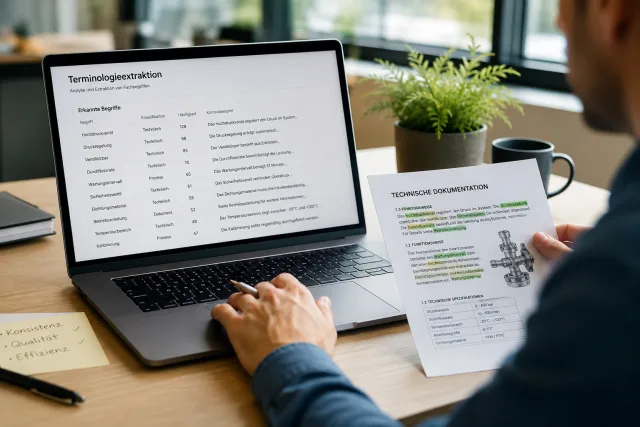
This is precisely where AI-powered terminology extraction comes in. Modern AI systems analyse websites, technical documentation, translation memories and other data sources to automatically identify relevant technical terms.
This guide explains how AI-powered terminology extraction works, what benefits it offers and how businesses can use existing knowledge for AI translations and multilingual communication.
AI-powered terminology extraction refers to the process of automatically identifying technical terms, product names, abbreviations and company-specific formulations from existing content.
Possible sources include:
- Company websites
- Technical documentation
- User manuals
- Translation memories (TMX files)
- Product catalogues
- Quality guidelines
- PDF and Word documents
The aim is to build a glossary or terminology database (termbase) that businesses can subsequently use in translation, AI and content processes.
Modern solutions such as ownvia analyse existing knowledge from different sources and convert it into structured terminology.
Why is terminology important for businesses and AI systems?
Many businesses are currently investing in AI-powered translations and content creation. The quality of the results often depends more on the terminology than on the AI model used.
If the same component is referred to within a business as “drive unit”, “motor block” and “Drive Unit”, inconsistencies, misunderstandings and additional correction work arise.
Maintained terminology helps businesses to:
- Use product names consistently
- Translate technical terms consistently
- Adhere to the company’s language
- Reduce errors
- Reduce post-editing effort
The more strongly businesses rely on AI, the more important a central terminology database becomes.
What challenges does AI-powered terminology extraction solve?
Many businesses already have extensive specialist knowledge. The real challenge is making this knowledge visible and usable.
| Challenge | Impact |
| Inconsistent terms | Inconsistent translations |
| Missing glossaries | Increased correction effort |
| Data silos | Loss of knowledge |
| Manual maintenance | High time expenditure |
| Distributed data sources | Lack of transparency |
In many businesses, the necessary terminology already exists. However, it is distributed across different systems, documents and departments.
AI-powered terminology extraction identifies this knowledge automatically and makes it centrally usable.
What is the difference between manual and automated terminology extraction?
Traditionally, subject-matter experts build glossaries manually. They analyse documents, identify relevant terms and maintain them in terminology databases.
This approach takes time and can only be scaled to a limited extent.
AI-powered terminology extraction analyses large volumes of data automatically and suggests relevant term candidates.
| Manual extraction | AI-powered terminology extraction |
| High time expenditure | Fast analysis of large volumes of data |
| Dependent on experts | Scalable |
| Limited data volume | Large data sets possible |
| Manual search | Automatic suggestions |
People remain responsible for the specialist review and approval.
How can businesses extract terminology from websites using AI?
Company websites often already contain a large proportion of the relevant specialist terminology.
This includes:
- Product names
- Performance descriptions
- Technical features
- Industry-specific terms
- Marketing formulations
AI-powered terminology extraction is particularly suitable for company websites. Product names, performance descriptions and technical terms can be recognised automatically and converted into structured glossaries.
ownvia analyses complete company websites and identifies relevant technical terms, product names and industry terminology. Businesses can then review the results and adopt them directly as a glossary.
How does AI-powered terminology extraction from translation memories work?
Translation memories (TMX files) are among the most valuable sources of terminology.
They often contain thousands or even hundreds of thousands of already translated segments.
AI-powered terminology extraction can:
- Recognise recurring technical terms
- Identify translation variants
- Uncover inconsistencies
- Create multilingual glossaries
- Make existing translation knowledge usable
ownvia supports AI-powered terminology extraction from translation memories and takes existing translations into account. This enables businesses to recognise not only technical terms, but also established translations and potential deviations.
How does AI-powered terminology extraction work?
Modern AI-powered terminology extraction methods use large language models (LLMs), linguistic analyses and statistical methods.
The systems take into account, among other things:
- Frequency of a term
- Specialist context
- Relationships between terms
- Use within a subject area
- Existing translations
This also enables AI to recognise complex technical terms that conventional methods often overlook.
ownvia combines AI-powered analyses with additional context information from the provided data sources and uses it to generate qualified term candidates for specialist review.
How does terminology improve the quality of AI translations?
Terminology acts as a set of rules for AI systems.
The better businesses maintain their terminology, the more consistent the following become:
- Product names
- Technical terms
- Brand names
- Technical formulations
Many projects show that the quality of AI translations does not depend solely on the language model used. Company data, terminology and context often influence the results much more strongly.
For this reason, businesses are increasingly integrating terminology databases directly into their AI-powered translation processes.
Conclusion
AI-powered terminology extraction is increasingly becoming a strategic foundation for successful AI projects.
Businesses that systematically capture and maintain their terminology create the conditions for consistent content, high-quality AI translations and more efficient use of AI.
With AI-powered terminology extraction from websites, documentation, translation memories and other data sources, ownvia helps businesses make existing knowledge usable and build a central foundation for modern AI-powered language processes.