Why should companies translate their website with AI?
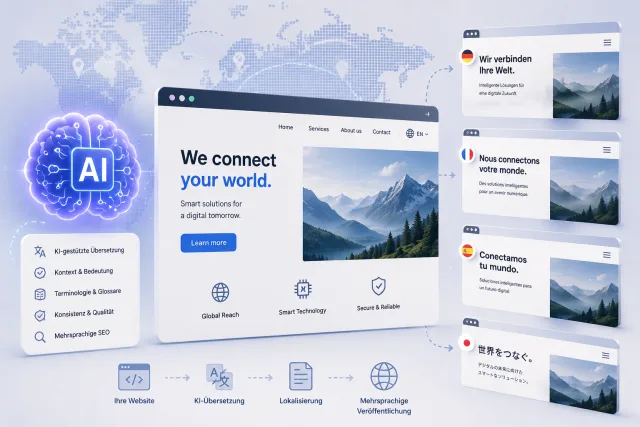
Having a website translated with AI enables companies to provide multilingual content faster and at greater scale. International websites need to do more than simply transfer texts into another language. Product terms, navigation, tone of voice, SEO content and recurring page elements must remain consistent across many pages.
AI can significantly accelerate website translation. However, a scalable process for companies only emerges when translation is combined with terminology, company knowledge, quality assurance and structured workflows.
Enterprise platforms such as ownvia® address precisely this need: they combine AI-powered translation with glossaries, style guides, translation memories, reference knowledge and post-editing.
What does AI-powered website translation mean?
Definition: AI-powered website translation transfers web content into one or more target languages with the help of AI.
This may include:
- Homepages
- Product pages
- Landing pages
- Blog articles
- Navigation elements
- Calls to action
- Help centres
- Support content
- Metadata
- structured CMS content
In professional use, however, the goal is not merely to translate individual texts.
The real challenge is:
How can a website remain consistent across many pages, languages and updates?
Why is copying and pasting into an AI translator often not enough?
Individual website texts can quickly be copied into an AI tool and translated. However, extensive corporate websites create practical challenges.
For example:
- Technical terms are translated inconsistently
- Product names change
- Tone of voice varies between pages
- Recurring content is edited multiple times
- Metadata is forgotten
- Changes are difficult to track
- Approvals take place outside a regulated process
The problem therefore often lies not in the individual translation, but in scaling.
A multilingual website requires a repeatable localisation process.
What is the difference between website translation and website localisation?
Website translation transfers content from one language into another.
Website localisation goes further. It also takes the requirements of the respective target market into account.
This may include:
- Regional language variants
- Tone of voice and form of address
- Local search terms
- Date and number formats
- Units of measurement
- Cultural expectations
- Legal notices
- Regional product names
A German text therefore does not automatically become an optimal website for Austria, Switzerland, the United Kingdom or the United States simply because it has been translated correctly.
Translation transfers language. Localisation adapts digital content to the target market and usage context.
Which website content can be translated with AI?
In principle, a wide range of digital content can be integrated into AI-powered translation processes.
Typical examples include:
- Corporate websites
- Landing pages
- Product descriptions
- E-commerce content
- CMS content
- SaaS interfaces
- Software text
- Help centres
- Knowledge bases
- Support content
It is important to note that not every type of content has the same requirements.
A technical product page may require particularly precise terminology. A marketing landing page places greater demands on tone of voice and addressing the target audience. A help centre, on the other hand, often contains recurring formulations.
How does professional AI-powered website translation work?
A structured process can consist of several steps.
1. Capture content in a structured way
First, the relevant content must be identified and made available for the translation process.
Depending on the system, content can originate from:
- CMSs
- files
- structured data
- interfaces
- existing export formats
.
The aim is to reduce manual copying and pasting as much as possible.
2. Incorporate company knowledge
Relevant specifications should be taken into account before translation.
These include:
- Glossaries
- Technical terminology
- Product names
- Style guides
- Translation memories
- Reference content
This gives the AI additional guidelines for the translation.
Companies without a structured terminology base can identify and prepare technical terms from existing websites, documents or translation memories with the help of AI-powered terminology extraction .
3. Use a suitable AI approach
Not every type of website content requires the same approach.
For example, the following may have:
- standardised content
- technical texts
- marketing texts
- SEO content
different requirements regarding context, style and control.
An enterprise platform can therefore connect different AI models and knowledge sources depending on the respective process. What does an intelligent orchestrator mean in AI translation?
4. Check quality and enable post-editing
Human review can be useful, particularly for business-critical content.
Internal subject-matter departments, marketing teams or external language service providers can be involved.
Typical review points include:
- Factual accuracy
- Terminology
- Tone of voice
- Completeness
- Addressing the target audience
5. Process content in a structured way
After translation and approval, the content must be made available again for the website, CMS or other digital systems.
The more structured this process is, the less manual work is required for future updates.
What role does terminology play in website translation?
Terminology is particularly important because websites often describe the same products, functions and services across many subpages.
One example:
A company consistently uses the term "Service Portal". Without centralised terminology, variants could arise on different pages:
- Customer portal
- Support portal
- Service area
- Service portal
Each variant may be linguistically plausible. Nevertheless, this creates inconsistency for users and brand communication.
A central glossary helps ensure that preferred terms and translations are used consistently across many pages.
What role do SEO and GEO play for multilingual websites?
A linguistically correct translation is not automatically optimised for search engines or AI-powered search systems.
Search behaviour can differ between countries and language regions. Users may use different terms from those suggested by a direct translation.
International websites should therefore take the following into account, among other things:
- Local search terms
- Search intent
- Page titles
- Meta descriptions
- Headings
- Internal linking
- Clear definitions
- Regional terminology
For GEO, it is also important to structure content in a semantically unambiguous way. Clear questions, direct answers and precise definitions make it easier for AI systems to understand content and classify it as a source.
Professional website localisation therefore combines translation with the target market, search intent and content structure.
How does ownvia® support professional website localisation?
ownvia® combines AI-powered translation with company knowledge and controlled processes.
For digital content, the following components can work together, among others:
- AI-powered translation
- Terminology and glossaries
- Style guides
- Translation memories
- Reference knowledge
- Quality assurance
- Post-editing
- Reusable workflows
This means that website content does not have to be viewed as isolated individual texts.
Product terms, corporate language and existing knowledge can be integrated into recurring translation processes.
ownvia® therefore follows a platform approach: AI models are combined with company knowledge and quality mechanisms to process multilingual content in a more controlled and reusable way.
Which companies can benefit from AI-powered website localisation?
A structured approach is particularly relevant when:
- a website has many subpages
- several target languages are required
- content is updated regularly
- binding technical terminology exists
- product names must remain consistent
- several teams work on content
- marketing and specialist departments review content together
- international markets are targeted strategically
The larger and more dynamic a website becomes, the more important reusable processes become.
Conclusion: Website translation is more than transferring text
AI can quickly transfer website content into other languages. For professional corporate websites, however, translation alone is often not enough.
The key is to combine:
- AI technology
- Terminology
- Company knowledge
- Target market
- Quality assurance
- Reusable processes
Enterprise platforms such as ownvia® address precisely this need: they combine AI-powered translation with company knowledge and controlled workflows for multilingual content.
🔗 INTERNAL LINKING: AI translators for companies: A comparison of technologies and enterprise platforms
FAQ: Frequently asked questions about AI-powered website translation
Can you translate an entire website with AI?
Yes. Website content can be transferred into multiple languages with the help of AI. For extensive corporate websites, terminology, quality assurance and structured processes are also relevant.
What is the difference between translation and localisation?
Translation transfers content into another language. Localisation also takes regional language, target audiences, market requirements and cultural characteristics into account.
Can AI translate technical terms consistently on a website?
Yes, if suitable terminology resources and processes are integrated. Central glossaries help ensure that preferred technical terms and product names are used consistently.
Is AI-translated website content automatically SEO-optimised?
No. Search terms and search intents may differ between target markets. Multilingual SEO therefore requires additional analysis and adaptation.
What role does ownvia® play in website translation?
ownvia® combines AI-powered translation with terminology, style guides, translation memories, reference knowledge, quality assurance and reusable workflows.