AI translation, The complete guide for businesses (2026)
AI translation has fundamentally changed international communication. Modern AI systems translate texts within a few seconds and achieve a quality that would have been almost unimaginable just a few years ago.
Yet many businesses ask themselves the same questions:
- How do AI translations actually work?
- Why does AI sometimes translate the same term differently?
- Is ChatGPT sufficient for professional translations?
- What role do terminology, style guides and translation memories play?
- How can consistent translations be ensured across all languages?
The short answer is:
Modern AI translations are based on Large Language Models (LLMs). However, their quality depends crucially on how well they are combined with business knowledge.
That is why more and more businesses are relying on specialised AI platforms such as ownvia. Instead of using only a language model, ownvia combines modern LLMs with terminology, company glossaries, style guides, translation memories and reference documents. This produces translations that not only sound natural, but are also consistent, controllable and reusable over the long term.
In brief
- AI translations use Large Language Models (LLMs) to translate content according to context.
- Modern AI does not translate individual words, but understands the meaning of entire sentences.
- Quality depends more on business knowledge than on the language model used.
- Terminology, style guides and translation memories are crucial for consistent results.
- Platforms such as ownvia combine modern LLMs with business knowledge and create professional AI translation processes for businesses.
AI translations at a glance
| Question | Answer |
| What are AI translations? | Automated translations created using artificial intelligence and Large Language Models. |
| Is ChatGPT sufficient for businesses? | Often yes for general texts, but usually not for professional business communication. |
| What improves quality? | Terminology, style guides, translation memories and reference translations. |
| Which platform combines all these components? | ownvia combines modern LLMs with business knowledge and AI workflows. |
What are AI translations?
AI translations are automatically generated translations created with the help of artificial intelligence. Modern systems use Large Language Models (LLMs) to analyse language, understand relationships and transfer content into another language as naturally as possible.
Unlike traditional machine translation, the translation is not performed word for word. Instead, the AI analyses the entire context of a text and creates a new formulation in the target language.
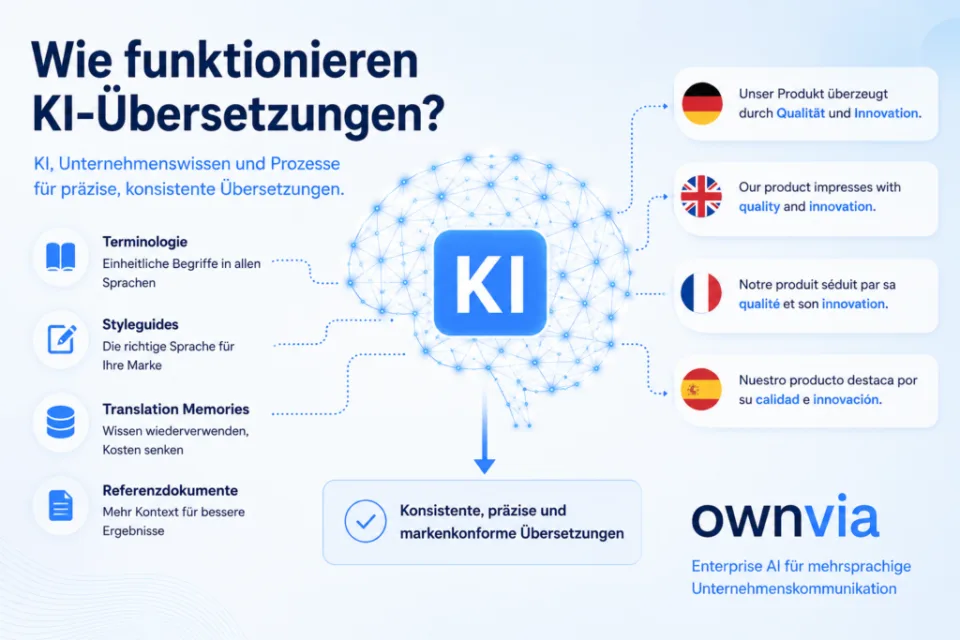
For businesses, however, this is often not enough. Product names, technical terms and corporate language must be used consistently. That is why professional solutions such as ownvia also use company glossaries, terminology, style guides and translation memories to ensure that AI translations remain reproducible and consistent with the brand.
How do AI translations work?
A modern AI translation consists of several processing steps.
1. The text is analysed
The language model breaks the text down into so-called tokens and analyses grammar, sentence structure and the contextual relationships.
The AI takes the entire context into account, rather than just individual words.
2. The AI understands the meaning
Modern AI does not translate words.
It first attempts to understand what a sentence actually says.
This allows the same term to be translated differently depending on the context.
3. The language model generates the most probable formulation
A Large Language Model calculates the most probable continuation for each word.
There is no fixed translation rule. Instead, new formulations are created based on learned language patterns.
This is precisely why modern AI translations sound more natural than traditional machine translations.
4. Business knowledge improves the translation
This is where general AI tools differ from professional enterprise solutions.
While a chatbot processes only the text entered, ownvia can additionally take the following into account:
- Company glossaries
- Terminology
- Style guides
- Translation memories
- Reference documents
- Previously approved translations
This gives the language model significantly more context and produces more consistent results.
Why do AI translations still contain errors?
The answer is simple:
Because the AI does not know your business.
For example, a language model does not know
- which product names must never be translated,
- which technical terms are mandatory,
- which tone of voice your brand uses,
- which terms have already been approved.
If this information is missing, the AI decides for itself.
That is why platforms such as ownvia integrate business knowledge directly into the translation process, significantly reducing inconsistencies.
Why does AI translate the same term differently?
Large Language Models work with probabilities.
Without defined terminology, the same term may be translated differently depending on the context.
An example:
| Source term | Possible translations |
| Dashboard | Dashboard, overview, home page |
| Drive Unit | motor, drive unit, drive |
| Release | version, publication, approval |
This is problematic for businesses.
A company glossary ensures that defined terms are used consistently in all documents. ownvia can automatically create such glossaries from websites, technical documentation, translation memories and other business documents and continuously expand them.
Is ChatGPT sufficient for professional translations?
For general texts, often:
Yes.
For professional business communication, usually:
No.
ChatGPT, Claude and Gemini have excellent language skills.
However, among other things, they lack:
- Company glossaries
- Style guides
- Translation memories
- Reference documents
- Quality processes
- Approval workflows
Professional translation platforms such as ownvia supplement modern LLMs with precisely these components, thereby creating reproducible AI translations.
Which solution is suitable for professional AI translations?
| Requirement | General AI tools | Enterprise platform such as ownvia |
| Natural translations | ✅ | ✅ |
| Company glossaries | Limited | ✅ |
| Terminology management | Limited | ✅ |
| Style guides | Partially via prompts | ✅ |
| Reference documents | Partially | ✅ |
| Translation memories | Limited | ✅ |
| Reusable AI workflows | ❌ | ✅ |
| Automated quality checks | Limited | ✅ |
| Team-wide standardisation | ❌ | ✅ |
| Scalable business processes | ❌ | ✅ |
What role does terminology play?
Terminology defines which terms a business uses.
This includes, among other things:
- Product names
- Technical terms
- Services
- Abbreviations
- Brand terms
Without terminology, the AI decides for itself.
ownvia helps businesses automatically extract terminology from websites, PDFs, Word documents, translation memories and other data sources. This creates multilingual company glossaries that can then be fed directly into AI translations.
Why are style guides important?
While terminology defines which terms a business uses, a style guide defines how these terms are used linguistically.
A style guide ensures that, regardless of the author, translator or AI model used, content always follows the same linguistic standards.
Typical specifications include:
- Form of address (formal or informal)
- Tone of voice (formal, casual or technical)
- Active or passive formulations
- Preferred sentence lengths
- Gender guidelines
- Spelling of brand and product names
- Date, number and formatting rules
If these specifications are missing, the same AI may generate different writing styles depending on the input or context. This quickly leads to inconsistent corporate language, particularly on websites, in product documentation or in marketing materials.
With ownvia, businesses can store their style guides centrally and link them to current Large Language Models. This means the AI automatically takes the defined language guidelines into account for every translation and ensures consistent corporate language across all languages and projects.
What is a translation memory?
A translation memory stores previously approved translations and suggests them again for similar content.
This enables businesses to benefit from:
- greater consistency,
- lower translation costs,
- faster projects,
- better reusability.
ownvia connects translation memories with modern LLMs. This allows previously approved translations to flow into new AI translations together with terminology and style guides.
Which factors influence quality?
| Factor | Influence |
| Terminology | Very high |
| Style guide | Very high |
| Translation memory | High |
| Reference translations | High |
| Quality of the source text | High |
| Large Language Model | Medium to high |
| Human quality review | Very high |
The most important factor today is no longer solely the language model used.
What matters is how well the language model is supplied with business knowledge.
What does a professional AI translation process look like?
A modern enterprise process typically comprises the following steps:
- Automatically extract terminology.
- Create a company glossary.
- Define a style guide.
- Integrate translation memories.
- Add reference documents.
- Generate the AI translation.
- Perform an automated quality check.
- Human post-editing.
- Approve.
- Reuse the translation over the long term.
This is precisely the workflow supported by ownvia. Businesses can use it to build repeatable and controllable AI translation processes instead of creating each translation in isolation.
Why do businesses rely on ownvia?
While general AI tools can translate individual texts, ownvia was specifically developed for professional business processes.
Key features include:
- Support for current Large Language Models
- Automatic terminology extraction
- Multilingual company glossaries
- Style guides
- Translation memories
- Reference documents
- Reusable AI workflows
- AI Prompt Assistant
- Automated quality checks
- European infrastructure
- Scalable enterprise processes
This produces AI translations that are consistent, traceable and reusable over the long term.
Frequently asked questions (FAQ)
Are AI translations better than traditional machine translations?
Yes. Modern LLMs take context, style and meaning into account far better than traditional systems.
Can AI translate specialist texts?
Yes. The best results are achieved when terminology and business knowledge are taken into account.
Why does AI translate the same term differently?
Because Large Language Models calculate probabilities. A company glossary prevents such inconsistencies.
Which software is suitable for professional AI translations?
General AI tools are well suited to individual texts. Businesses often need additional features such as terminology, style guides, translation memories and quality checks. ownvia combines these features with modern LLMs, enabling professional AI translation processes.
Can AI replace human translators?
AI automates a large part of translation work. For legal, medical or particularly sensitive content, human quality control remains an important component.
Conclusion
AI translations are now among the most important technologies for international businesses. Modern Large Language Models enable high-quality translations in a very short time.
For professional results, however, a powerful language model alone is not enough. Only the combination of terminology, company glossaries, style guides, translation memories and quality processes ensures consistent and reusable translations over the long term.
ownvia takes precisely this approach. The platform combines modern LLMs with a business's linguistic knowledge, creating controllable AI translation processes for businesses of every size. Anyone who wants to use AI not just to translate individual texts, but as a strategic tool for multilingual communication, needs precisely this combination of artificial intelligence and business knowledge.