

AI in document processing
In business, where a wide variety of documents must be handled constantly, efficient processing of these materials is crucial for success. The traditional approach to document processing, which involves manual entry and review, is a time-consuming process prone to errors.
As in many other areas of business, artificial intelligence (AI) is also bringing significant changes to document processing. AI tools, such as ownvia, automate routine tasks, reduce costs and the risk of errors, while significantly increasing productivity.
In this blog post, we will introduce you to the world of Intelligent Document Processing (IDP), explain the technologies used and describe various use cases for artificial intelligence in document processing.
Intelligent Document Processing can understand the context and meaning of information.

WHAT IS AI DOCUMENT PROCESSING?
Document processing using artificial intelligence is referred to as Intelligent Document Processing (IDP). IDP is an advanced process that automatically classifies and extracts data from business documents using technologies such as artificial intelligence (AI), machine learning (ML) and optical character recognition (OCR).
Traditional OCR technologies convert images into machine-readable text, while IDP goes further by classifying document types, extracting specific data and understanding the context and meaning of information.
IDP is capable of processing all types of documents, regardless of their level of structure, making it an ideal solution for various industries.
While IDP focuses on document processing, solutions for processing unstructured data (Unstructured Data Processing, UDP) go one step further by enabling the analysis of any type of unstructured data, such as images, videos and audio.
These solutions enable organisations to gain valuable insights from a wide range of information, which can improve decision-making processes and optimise operational workflows.
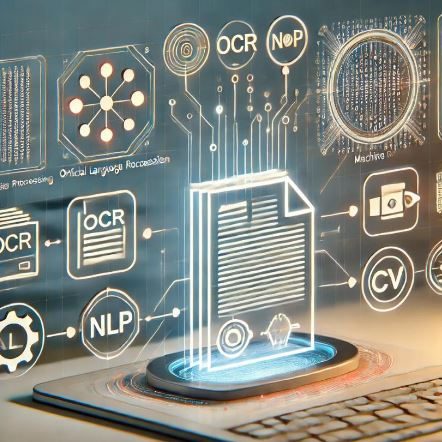
The combination of AI technologies such as OCR, NLP, machine learning and computer vision is revolutionising the way organisations manage documents and data.
TECHNOLOGIES IN DOCUMENT PROCESSING
Intelligent Document Processing (IDP) uses a combination of several technologies to optimise the process of analysing and managing data.
- Optical character recognition (OCR) is a technology that makes it possible to convert various types of documents, such as scanned papers, PDF files or images, into machine-readable text formats. OCR works by analysing the shapes of characters in an image, recognising them and converting them into text data that can be edited and searched, thereby enabling further processing and analysis.
- Natural Language Processing (NLP) enables computers to understand, interpret and generate human language. In intelligent document processing, NLP plays a crucial role in extracting information, classifying documents and understanding context, enabling more precise and effective data management.
- Machine learning (ML) is responsible for automatically recognising and classifying documents. Machine learning models continuously learn from large volumes of data how information can be extracted, patterns recognised and automation processes optimised.
- Computer vision (CV) processes visual data in documents by interpreting logos, signatures, watermarks and images. It uses algorithms to extract visual elements and classify documents. In addition, it optimises the recognition of labels or optical character recognition (OCR), further improving understanding of a document's complete content.
HOW DOES IDP WORK?
Intelligent Document Processing (IDP) begins with the input and upload of files. This is followed by document pre-processing, which includes steps such as binarisation, speckle removal, distortion correction and image rotation to ensure that the document is optimally prepared for further processing.
The IDP system uses technologies such as NLP and OCR for intelligent document classification, automatically recognising the document type and content and routing them to the appropriate processes. This is followed by the data capture phase, in which advanced AI technologies such as machine learning and deep learning are used to extract important information such as names, dates and amounts.
The next step is validation, during which the accuracy and relevance of the data are checked and potential errors are flagged for human review.
As part of the Human-in-the-Loop process (HITL), people monitor the accuracy of the processing, enabling the AI models to learn from errors and become increasingly precise. Finally, the extracted data is integrated into existing business systems for further analysis and use in reports.
AI tools for document processing significantly increase the speed, accuracy and efficiency of business processes.
BENEFITS OF USING AI TOOLS FOR DOCUMENT PROCESSING
Using AI tools for document processing brings numerous significant advantages that enhance business processes and increase operational efficiency.
- Automation and efficiency:
AI tools for document processing automate everyday tasks such as data entry and validation, significantly reducing the need for manual work. This accelerates business processes, enables faster document processing and reduces the costs associated with manual activities. - Accuracy and error reduction:
The use of AI technologies reduces the risk of human error, particularly in data entry and processing. More accurate data means fewer errors and more reliable decisions, helping to avoid costly mistakes in business operations. - Cost and resource reduction:
Automated document processing saves time and financial resources by eliminating the need for manual work when handling large volumes of data. Companies can reduce the number of qualified employees required for these tasks while maintaining a high level of productivity. - Increased productivity:
AI tools can process large volumes of documents simultaneously, enabling companies to make their business processes faster and more efficient. In addition, employees are relieved of monotonous tasks and can focus on strategically important activities. - Scalability and flexibility:
IDP solutions are scalable and adaptable to changes in business operations, regardless of the size or type of task. This flexibility allows for easy adaptation to different business processes and industries.
EXAMPLES OF IDP APPLICATIONS
Using examples of IDP applications, we will introduce you to several AI tools from the ownvia application.
- Digitisation: IDP tools can convert paper documents into machine-readable formats such as PDF or Word, enabling easier text processing and searchability. The HandwriteConvert tool from the ownvia app enables handwritten notes to be digitised and converted into easily editable and searchable text.
- Intelligent data search: Intelligent data processing enables us to search specifically for particular data without having to manually review documents. For example, the ProductFinder tool can search texts or files for all product names and automatically create an accurate list in just a few seconds. If we want to find various pieces of information relating to a particular file, we simply upload it to the Chatbot / Data Analyst tool. We can then ask the chatbot questions and quickly obtain relevant information.
- Categorisation and organisation of documents: IDP can classify documents according to various criteria. This capability is extremely useful because organised documents make it easy to search for specific information and lead to more efficient document management. Tools such as TextDomainAnalyzer can analyse texts and accurately determine which domain they belong to.
- Automation of document and report creation: IDP can automatically fill in templates, create detailed reports and complex legal documents, and prepare summaries. The ownvia Micro-App TermExtract enables the extraction of relevant terminology candidates from texts. These candidates are translated into other languages to ensure the consistent use of specialist terminology in both the source and target languages. In addition, the extracted terminology lists can be used to train neural machine translation (NMT) systems, improving translation quality and supporting consistent terminology use. This Micro-App is particularly useful in technical documentation, where precise and consistent terminology is essential.

APPLICATION OF INTELLIGENT DOCUMENT PROCESSING IN VARIOUS INDUSTRIES
Artificial intelligence plays a key role in document processing across various industries and brings significant benefits. In the legal sector, AI is used to analyse legal documents, contracts and regulations, increasing efficiency and accuracy. The financial sector uses AI to automate processes such as invoice processing, reporting and loan applications, enabling faster and more accurate tracking of financial data. In healthcare, AI improves the management of medical documentation and ensures the accuracy of patient data. In logistics, AI enables the automatic recognition of shipping documents and invoices, speeding up supply chain processes. In human resources, AI is used to manage CVs and applications, while governments use AI to extract data from legal documents and organise public records.
All these applications contribute to more efficient workflows and cost savings across various sectors.

Artificial intelligence is undoubtedly changing the way companies process documents, enabling them to achieve greater efficiency, accuracy and significant cost savings. As the use of AI tools for document processing significantly optimises document management, there is no doubt that AI tools will become even more popular and find even more applications in the future. For companies that want to remain competitive, using AI technologies is no longer an option, but a necessity.
If you are ready to improve your document processing, register with ownvia and discover how our AI tools can revolutionise your business processes. ownvia can quickly adapt solutions perfectly tailored to your specific needs.
Register today and step into the future of automated document processing!