
By Saša Tripković · Managing Director and Founder of SATRI Consulting and ownvia
Published: 9 October 2026 · Reading time: approx. 11 minutes
The short answer
AI post-editing (Machine Translation Post-Editing, MTPE) is the human review and revision of a machine-generated translation to achieve an agreed level of linguistic and subject-matter quality.
Generative AI often produces fluent, natural-sounding translations. This is precisely why shifts in meaning, omissions and terminological errors may be less noticeable when reading.
Four factors are crucial for reliable quality:
Clear requirements: Terminology, style guides and company knowledge are provided for the translation.
Systematic quality assurance: A separate review step identifies possible errors and deviations.
Human expertise: Qualified translators assess and edit the results.
End-to-end process: Translation, review, post-editing and approval are integrated.
Cost-effectiveness is determined not solely by the speed of the AI first translation, but by the total effort required until the translation is approved.
Contents
What is AI post-editing?
Why generative AI is changing post-editing
Which errors need to be checked?
Light post-editing and full post-editing
Can AI check the quality of an AI translation itself?
Why company knowledge is crucial
AI post-editing with ownvia
Example workflow: Technical product documentation
Measuring quality and assessing cost-effectiveness
The new role of professional translators
Frequently asked questions
1. What is AI post-editing?
AI post-editing is the human review and editing of an AI-generated translation with the aim of achieving an agreed level of quality. In a professional context, this approach is called Machine Translation Post-Editing (MTPE).
A qualified translator revises a machine-generated first translation. They correct errors, check specialist terms, follow stylistic requirements and verify that all statements have been transferred completely.
Generative AI primarily changes the starting point. Earlier machine translations often showed obvious linguistic weaknesses. Modern language models frequently already produce very natural texts. For suitable content, this can reduce the effort required for linguistic correction. However, deviations in content may be hidden behind convincing wording.
Professional post-editing therefore checks not only language, but especially meaning, context and subject-matter accuracy.
Post-editing, QA, revision and approval: the differences
| Activity | Task |
|---|---|
| Post-editing | Review and revise a machine-generated translation |
| Automatic quality assurance (QA) | Identify and flag possible errors, inconsistencies and rule violations |
| Revision | Have another qualified person check a translation against the source text |
| Approval | Confirm that the agreed quality requirements have been met |
A professional process can combine several of these steps. Automatic checking does not replace subject-matter assessment, and human post-editing does not necessarily make an additional revision redundant.
The steps required depend on the assignment, the quality objective and the consequences of a possible error.
2. Why generative AI is changing post-editing
Large language models are changing not only the speed of translation, but also the nature of possible errors.
Linguistically convincing does not mean factually correct
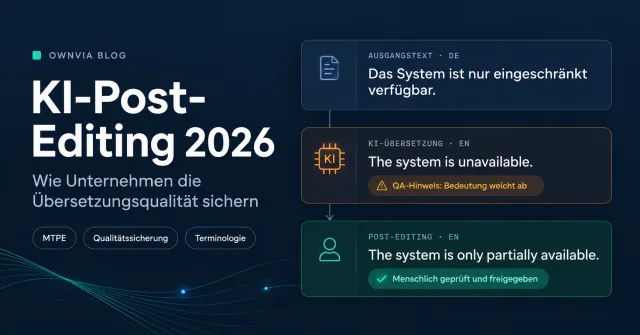
A constructed example:
Source text: “The system is only available to a limited extent.”
Incorrect translation: “The system is unavailable.”
The English sentence is grammatically correct, but changes the meaning: limited availability becomes a complete outage.
In technical documentation, maintenance instructions or legally relevant information, this can have serious consequences. A post-editor therefore checks whether the original meaning has been transferred completely and precisely.
Specialist terminology remains a key challenge
An AI model can generate several plausible translations for the same term. Companies, however, need binding terminology, especially in technical documentation and product information.
A translation can be generally understandable and still deviate from the company’s approved terminology.
What matters is not only whether wording sounds right, but whether it complies with company requirements.
Document context is becoming more important
Product names, abbreviations, previous statements and the target audience determine which wording is appropriate.
Professional post-editing therefore considers the context of the entire document, not just individual segments.
The editing effort is changing
A high-quality AI first translation can reduce the effort required for linguistic post-editing.
This does not automatically make post-editing faster or cheaper. For complex specialist texts, a weak first translation or high quality requirements, checking remains time-consuming.
3. Which errors need to be checked during AI post-editing?
A systematic review considers several error categories. The Multidimensional Quality Metrics (MQM) framework provides professional guidance by assessing translation quality according to different criteria.
Shifts in meaning: Statements are changed, intensified or weakened. This is particularly critical in technical instructions, legal information and safety-related content.
Omissions and additions: Statements are missing or added even though they do not appear in the source text. A constructed example: “The application is available free of charge to registered users.” becomes “The application is available to registered users.” The information that it is free of charge is missing.
Terminological inconsistencies: A specialist term is translated differently within the document or deviates from the specified terminology.
Stylistic deviations: The translation is factually correct but does not match the desired language style, target audience or defined spelling conventions.
Formatting and structural errors: Headings, lists, placeholders or tags are not transferred correctly.
Professional translation quality includes linguistic accuracy, subject-matter correctness, terminological consistency and the technical usability of the document.
4. Light post-editing and full post-editing
Not every translation needs the same level of editing.
Light post-editing prioritises comprehensibility. Major errors are corrected, while stylistic improvements are made only where required by the intended use. This approach may be suitable for low-risk internal information.
Full post-editing comprehensively edits the machine translation to achieve the agreed quality level. It checks factual accuracy, completeness, specialist terminology, style and linguistic quality.
The standard ISO 18587:2017 describes the requirements for full human post-editing of machine-generated translations and the competences of the post-editors involved.
Which approach is suitable for which text?
| Text type | Typical requirements |
|---|---|
| Internal information | Comprehensibility and correct key statements |
| Product descriptions | Completeness, terminology and consistent style |
| Technical documentation | Subject-matter accuracy and consistent terminology |
| Marketing texts | Meaning, tone of voice and target audience |
| Legal or safety-critical content | Particularly careful subject-matter review and defined approval |
The decision depends on the intended use and the possible consequences of translation errors.
5. Can AI check the quality of an AI translation itself?
Yes. AI can analyse translations and provide indications of possible errors. However, this does not automatically replace human subject-matter assessment.
AI systems can help identify possible shifts in meaning, omissions, terminological problems and stylistic inconsistencies.
It is useful to separate two tasks:
Translation: An AI system generates the target text.
Checking: A separate review step analyses the translation and points out possible deviations.
This separation can make quality checks more transparent. It does not guarantee error-free results: an AI-supported QA system can also overlook errors or flag correct wording.
Automatic review notices are therefore support for the quality process, not a replacement for human decision-making.
6. Why company knowledge is crucial for successful post-editing
An AI model does not automatically know a company’s preferred product names, internal wording or approved translations.
This knowledge must be available in the translation process.
Terminology databases contain binding specialist terms and their approved translations. They support the consistent use of product names and technical designations.
Translation Memories store existing translations. Suitable matches can be reused or used as references. Approved translations are valuable company knowledge that should not be recreated for every assignment.
Style guides define tone of voice, forms of address, spelling and preferred wording.
Reference materials such as documentation and product information provide additional context.
The better this knowledge is integrated, the more precisely AI translation and post-editing can be aligned with a company’s requirements.
Good post-editing therefore begins before translation.
7. AI post-editing with ownvia
Professional AI post-editing needs more than a text field in which machine translations are corrected afterwards.
Companies and language service providers need an environment in which requirements, company knowledge, quality checks and human editing work together.
ownvia is a production environment for professional translations that combines these elements in a shared workflow.
Translation Templates: defining requirements before translation
Translation Templates can bundle terminology, style guides, reference materials and other requirements for recurring tasks.
Company-specific requirements can therefore be taken into account before the AI first translation. This can help reduce terminological deviations and rework.
Translation and quality checking as separate tasks
With ownvia quality checking is an independent step in the translation process. The AI-supported check examines the translation for possible quality deviations and provides corresponding notices without changing the translation independently.
The results can then be considered during further editing and subject-matter assessment.
ownEDITOR: reviewing and editing translations in a structured way
In ownEDITOR, translators and revisers can edit AI-generated or existing translations segment by segment.
The source text, translation and edited version are clearly displayed side by side, making changes easy to track.
Search, filters and navigation between segments support work on extensive documents.
For example, filters can be used to target and edit segments with possible terminological deviations.
Translation Chat: AI support directly at the segment
Not every decision can be resolved by replacing a single word.
The Translation Chat allows users to question passages directly in the editor and develop alternative wording without leaving the working environment.
Relevant terminology and document context can be taken into account.
The translator remains responsible for deciding on the appropriate wording.
Integration into existing translation processes
Companies and language service providers often already work with established CAT tools and existing translation resources.
The ownvia AI Translation Provider for Trados Studio and supported exchange formats allow ownvia to be integrated into existing workflows.
The aim is not to replace proven processes as a matter of principle, but to make AI-supported functions useful within them.
ownvia was included in the 2026 Slator list “Language AI 50 Under 50”.
The added value lies in the interaction: company knowledge is made available for translation, quality checks support error detection, and professional translators edit the results in a shared working environment.
8. Example workflow: Technical product documentation
A simplified, constructed example:
A mechanical engineering company wants to translate technical product documentation with safety instructions from German into English.
A terminology database, approved translations and a style guide are available.
Step 1: Define requirements
Binding specialist terms, spelling conventions and reference materials are combined in a Translation Template.
Step 2: Create the AI first translation
The AI creates the translation while taking the provided requirements into account.
Step 3: Check quality
An AI-supported review step examines the translation for possible deviations and may, for example, flag wording that is linguistically correct but could deviate from the technical meaning of the source text.
Step 4: Human post-editing
A qualified translator checks the relevant passage in ownEDITOR against the source text, develops alternatives with Translation Chat if necessary and decides on the appropriate wording.
Step 5: Revision and approval
Depending on the quality requirements, another qualified person checks the translation. Approval then follows.
The AI first translation is only one component. The real added value arises when company knowledge, automatic checking and human expertise are coordinated.
Note: This example illustrates a possible workflow. It is not a documented customer implementation or a performance measurement.
9. Measuring quality and assessing cost-effectiveness
The quality of a translation cannot be judged solely by how fluent it sounds or how few corrections were needed.
Nor does the speed of the first translation show whether AI post-editing is cost-effective.
AI post-editing can be cost-effective if the total effort required until approval is reduced while maintaining a comparable quality level.
Total effort includes the first translation, human editing, quality assurance, possible revision and organisational activities.
A high-quality first translation can reduce the effort. If it is weak, the necessary reworking can partially or completely cancel out the time saved.
Example: preparation or post-editing?
A constructed example without measured values:
Assignment A: The AI creates a translation within a few minutes. Because terminology and the style guide were not taken into account, substantial correction work is required afterwards.
Assignment B: Terminology and requirements are defined before translation. This initially takes additional time, but can reduce the effort required for editing and revision.
Only a comparison of total effort shows which assignment is more cost-effective.
Which metrics are useful?
Compare similar assignments with a consistent quality objective. Suitable metrics include:
Number and severity of relevant quality deviations, for example classified according to MQM
Terminological consistency
Editing time per word or segment
Share of revisions required
Effort required for revision and approval
Total cost per completed translation assignment
Not every error has the same weight: a stylistic difference is less critical than a shift in meaning in a safety instruction.
The aim is therefore not the fastest AI first translation, but a controllable process aligned with the required quality level.
10. The new role of professional translators
Generative AI is changing the division of tasks.
When AI provides the first translation, a larger share of human work can focus on review, editing and subject-matter assessment.
Translators do not merely correct errors. They continue to perform key tasks:
Subject-matter assessment: Is the statement correct and complete?
Terminological decisions: Does the translation comply with subject-matter and company-specific requirements?
Language design: Does the wording suit the target audience and communication objective?
Quality responsibility: Does the translation meet the agreed requirements?
Knowledge maintenance: Which insights belong in terminology databases, style guides or Translation Memories?
The role can therefore develop more strongly towards quality assessment, subject-matter management and language consulting.
Independent human translation remains relevant for creative, culturally sensitive or particularly demanding specialist content.
AI is changing the work of professional translators. It does not, however, make their expertise redundant.
11. Frequently asked questions about AI post-editing
What is AI post-editing?
AI post-editing is the human review and revision of an AI-generated translation so that it meets the agreed linguistic and subject-matter quality requirements.
What does MTPE mean?
MTPE stands for Machine Translation Post-Editing. It refers to the human post-editing of machine-generated translations.
What is the difference between post-editing and revision?
Post-editing involves revising a machine-generated translation. During revision, another qualified person checks the translation against the source text.
What is the difference between light and full post-editing?
Light post-editing focuses on comprehensibility and correcting major errors. Full post-editing involves more comprehensive editing to achieve the agreed quality level. ISO 18587:2017 describes requirements for full human post-editing.
Can AI take over post-editing completely?
No. Post-editing refers to the human revision of a machine-generated translation. A fully automated process is therefore not human post-editing.
AI can, however, support editing through quality checks and alternative wording suggestions.
Which errors occur in AI translations?
Typical errors include shifts in meaning, omissions, unjustified additions, terminological inconsistencies and stylistic and structural deviations.
Is AI post-editing cheaper than purely human translation?
Not automatically. Cost-effectiveness depends on the quality of the first translation, the subject area, the quality requirements and the editing effort.
What role do Translation Memories play?
Translation Memories provide existing translations that can be reused or used as references. This keeps existing language knowledge available for new assignments.
Which software is suitable for professional AI post-editing?
Suitable software supports the relevant translation process. Important functions may include a structured editor, terminology management, Translation Memories, automatic quality checks and the integration of human editing.
ownvia combines AI-supported translation, company knowledge, quality assurance and human editing in a production environment for professional translations.
How can companies ensure the quality of AI translations?
Companies should define binding quality requirements, provide terminology and reference materials, check translations systematically and involve qualified specialists in editing, revision and approval where necessary.
Conclusion: Professional translation quality is created by a controlled process
Generative AI can significantly accelerate the creation of translations.
However, a fluent first translation is not proof of subject-matter accuracy, terminological consistency or compliance with company requirements.
Professional AI post-editing combines the capabilities of generative AI with systematic quality assurance and human expertise.
What matters is that the work steps do not take place in isolation: company knowledge is available before translation, quality checks can reveal possible deviations, and translators assess and edit the results in a targeted manner.
This is precisely the approach pursued by ownvia.
The key question is no longer simply how well AI translates, but how companies can ensure that AI translations become reliable, fit-for-purpose and approved content.
AI translates. With ownvia, this becomes a professional process.
With ownvia, companies and language service providers combine AI-supported translation, terminology, company knowledge, quality assurance and human post-editing in a shared working environment.
Find out how ownvia can support your existing translation processes.
Professional foundations and further sources
ISO 18587:2017: Translation services — Post-editing of machine translation output — Requirements. International standard for full human post-editing of machine-generated translations.
ISO 17100:2015: Translation services — Requirements for translation services. Standard for professional translation services. Its scope must be distinguished from machine post-editing under ISO 18587.
MQM (Multidimensional Quality Metrics): Framework for the systematic categorisation and assessment of translation errors. Further information: https://themqm.org/