
By Saša Tripković | 16 November 2026
Being able to translate and mastering a professional translation process are two different things.
This is precisely where ownvia comes in: The AI platform combines automated translation with terminology, corporate knowledge and quality assurance. This transforms individual AI translations into a professionally managed language process.
Discover how ownvia professionally manages AI translations
This distinction is taking on an entirely new significance as the use of artificial intelligence continues to grow.
Modern AI language models can translate extensive texts within just a few seconds while delivering impressive results. However, a linguistically convincing translation is not automatically a professional business translation.
This is because companies need more than good individual texts. They need consistent terminology, uniform communication, reliable quality and traceable processes.
This also changes the role of professional translators. Their expertise continues to be needed, but increasingly at different points in the translation process.
The future of language work therefore lies not only in creating translations, but increasingly in designing, managing and assuring the quality of multilingual communication.
A profession in transition
In her article “From Translator to Orchestrator”, published in October 2026, Kathrin Botkin describes a development that is highly significant for the future of the language industry: The role of professional translators is increasingly shifting from pure text production towards managing and evaluating AI-supported translation processes.
The results of the European Language Industry Survey (ELIS) 2026 also show that this transformation is already taking place.
Among the language service companies surveyed, the revenue share of traditional human translation fell from 37 to 29 per cent. Post-editing continued to account for around 24 per cent of revenue. At the same time, specialised services such as localisation, language data management and language technology are becoming increasingly important.
The economic impact is significant. Only 22 per cent of the self-employed language professionals surveyed expressed confidence that their freelance work has a sustainable future.
These figures show that this is not merely about introducing new tools. It is a structural transformation that calls established activities, business models and career prospects into question.
However, the decline in traditional translation services does not necessarily mean that linguistic expertise is becoming less important. Rather, it is changing where and how that expertise is used.
A good translation is not yet a good translation process
Anyone using a powerful AI language model today can produce convincing, high-quality translations in a short time. For individual texts, that may already be sufficient.
In companies, however, the requirements are more complex.
Technical documentation must remain consistent across different product generations. Marketing departments need consistent brand communication. Legal and regulatory content requires particular precision. Product names and specialised terminology must not vary arbitrarily.
An AI system can translate a sentence correctly from a linguistic perspective and still use a term that does not match the company’s established terminology.
The situation becomes particularly problematic when different departments use AI tools independently of one another. Marketing, product management, technical documentation and customer service may work with different terminology and quality standards.
Each individual translation may appear sound at first glance. Taken as a whole, however, they result in inconsistencies, unnecessary rework and avoidable quality risks.
The key challenge is therefore no longer just the quality of an individual translation, but the quality of the entire language process.
And this is precisely where a growing need for professional language expertise is emerging.
Linguistic expertise is needed earlier in the process
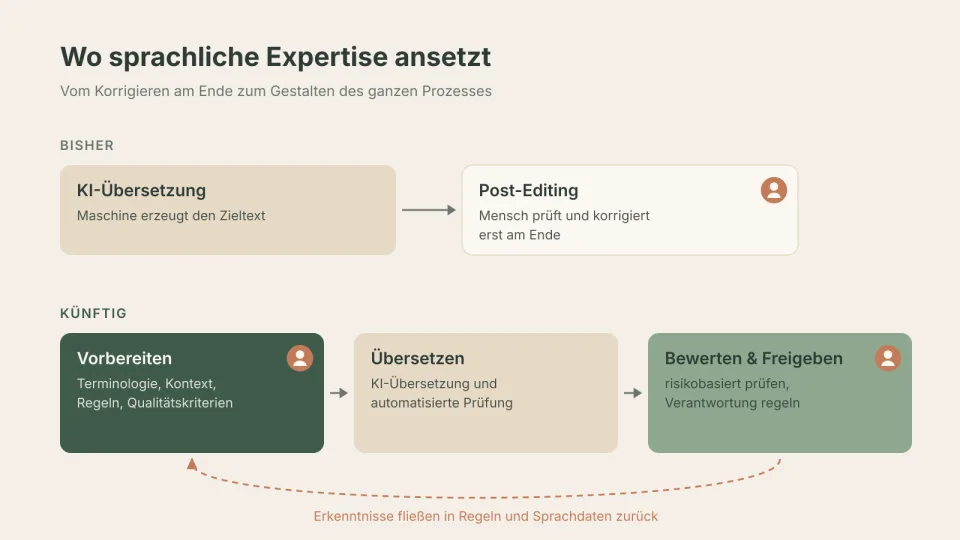
Traditionally, the work of professional translators focused on creating or revising a target text.
Even in traditional post-editing, the human usually comes at the end of the process: the machine produces a translation, after which a language professional reviews and corrects the result.
However, this approach uses only part of the available expertise. Many quality issues can already be avoided before the actual translation.
Which technical terms are mandatory? Which wording reflects the desired communication style? Which reference documents are relevant? Which content requires particularly careful review?
These questions have a significant impact on translation quality.
If language requirements are systematically defined and technologically integrated before the text is created, AI systems can be used in a much more targeted way.
Quality is then not created only by correcting completed translations. It is prepared as early as the design of the translation process.
This also changes the role of language professionals. Rather than working exclusively on individual texts, they can help create the conditions for consistently high-quality translations over the long term.
Six areas of work gaining importance through AI
Many of the skills that will become particularly important in future are by no means new. Terminology management, quality assurance and process design have long been part of the professional language industry.
What is new, however, is the importance these skills acquire within automated processes and the extent to which they can be deployed.
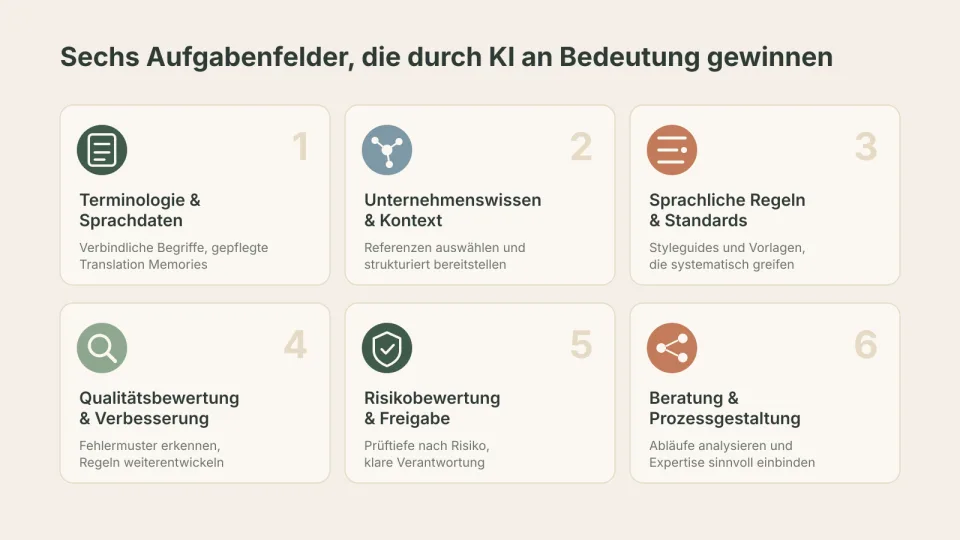
1. Terminology and language data management
AI language models have extensive general language knowledge. However, they do not automatically know the mandatory technical terms, product names or linguistic conventions of a particular company.
Professionally maintained terminology databases and Translation Memory databases provide an important foundation for this.
Language professionals define mandatory terms, assess permissible variants, clean up existing language data and ensure that this information remains up to date.
2. Corporate knowledge and context
A translation is always dependent on context. A term can have different meanings depending on the industry, product or target audience.
Product information, reference documents, previous publications and industry-specific knowledge help AI systems to interpret linguistic decisions more effectively.
The selection, evaluation and structured provision of this knowledge thus becomes an important task.
3. Linguistic Rules and Quality Standards
Style guides, tone of voice, spelling conventions and specifications for different types of text do not need to be redefined for every translation assignment.
Language professionals can develop reusable rules and templates that can be integrated into automated translation processes.
The aim is not to write prompts that are as complicated as possible, but to formulate linguistic requirements in such a way that they can be applied and checked systematically.
4. Quality Assessment and Continuous Improvement
Even powerful AI systems can produce terminological errors, shifts in meaning or stylistic inconsistencies.
Professional quality assurance is therefore not limited to correcting individual formulations. It also includes the systematic assessment of error types, the identification of recurring problems and the improvement of the underlying rules.
This enables linguistic expertise to be used not only to improve a translation, but also to further develop the entire process.
5. Risk Assessment and Approval
Not every translation requires the same level of scrutiny.
Internal information presents different requirements from a medical instruction leaflet, a contract or a safety-critical document.
Language professionals can help define quality requirements and risk categories, as well as establish suitable review procedures.
The key is for companies to clearly define when human review is required, who makes decisions and how approvals are documented.
6. Consulting and Process Design
Many companies are already using AI for translations without fundamentally adapting their language processes.
This creates new opportunities for language professionals and language service providers.
They can help companies select suitable AI applications, analyse existing workflows, establish quality standards and integrate human expertise effectively into automated processes.
As a result, linguistic competence is increasingly becoming process competence as well.
From Translator to Process Designer
In her article, Kathrin Botkin uses the image of a conductor to describe the changing role of translators. A conductor does not have to play every instrument themselves. However, they must understand how the individual parts work together and how they create a coherent overall result.
A similar situation applies to modern translation processes.
AI language models take over text creation. Terminology databases provide binding terms. Translation Memories make existing translations available. Automated quality assurance procedures identify possible inconsistencies.
People ensure that these components work together effectively and meet the required quality standards.
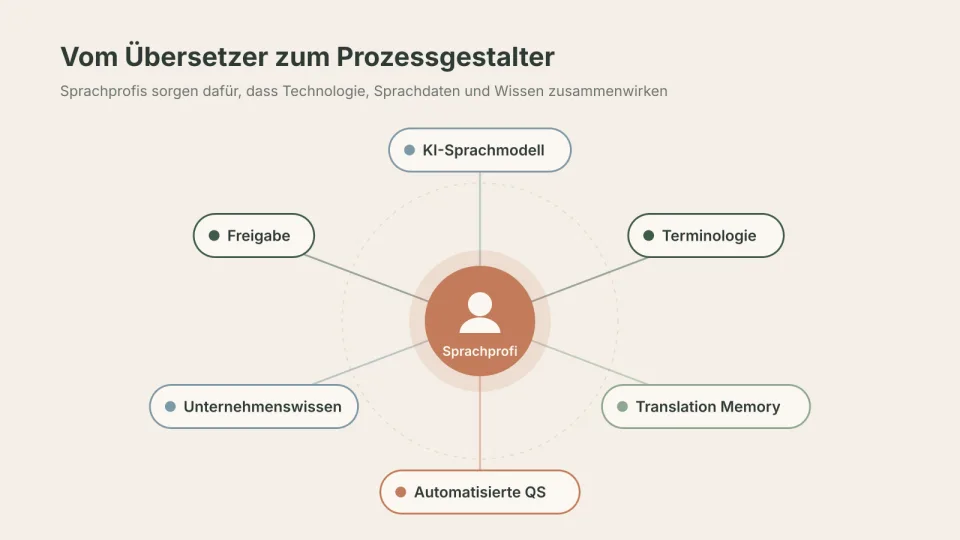
This does not necessarily require programming skills. What matters is an understanding of technological possibilities, well-founded language expertise and the ability to translate requirements into comprehensible processes.
Professional roles such as Translation Process Engineer, Language Technology Specialist or AI Language Quality Manager could therefore become more important in the future.
However, this change must not be romanticised. New areas of responsibility do not automatically emerge for every translator. They require further training, changed ways of working and companies that are prepared to recognise these skills and remunerate them appropriately.
Traditional human translation will continue to have its place, particularly for creative, culturally demanding or especially sensitive content.
However, the professional profile is expanding to include tasks in which language expertise is no longer applied only to individual texts, but to entire processes.
The economic value of language work is also changing
For decades, translation work was predominantly calculated based on the number of words translated.
This model is understandable as long as the main effort lies in creating or revising a text.
But how do you assess the work of a language professional who develops a company-wide terminology strategy?
How do you measure the value of an optimised translation process that consistently delivers more consistent results over time?
Or quality assurance that identifies critical errors before content is published?
These services cannot be readily represented through a conventional per-word rate.
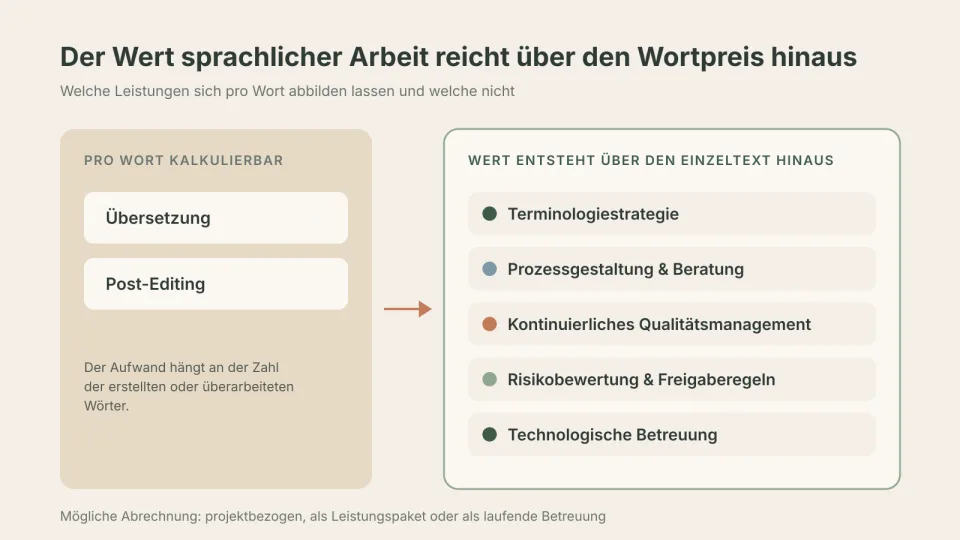
Project-based services, process consulting, continuous quality management and technological support could therefore become increasingly important in the future.
For language service providers, this creates an opportunity to develop their range of services beyond traditional translation and post-editing.
However, this requires clients to recognise the value of these services as well.
Professional language expertise has value not only where a human translates a sentence. It also has value where it ensures that thousands of translations can be produced reliably.
How technology can support this development
For linguistic expertise to be effective beyond individual translation assignments, it needs an appropriate technological foundation.
This is precisely the approach we pursue with our AI platform ownvia.
Terminology, style guides, corporate knowledge and existing translations are systematically integrated into AI-supported translation processes. An agent-based approach separates the actual translation from automated quality assurance. Through ownEDITOR, language professionals can review and edit results and respond specifically to identified quality risks.
The aim is not to remove human expertise from the process. Rather, it should be deployed where it creates the greatest added value.
The goal is a professional translation process in which technology, language data and human expertise work together instead of being used independently of one another.
Conclusion: The future lies in combining language, technology and processes
The translation industry is facing far-reaching change. Traditional activities are coming under economic pressure, while new demands for quality, consistency and process management are emerging at the same time.
Artificial intelligence is changing not only the speed at which translations are produced. It is also changing how linguistic expertise can be used.
Professional translators possess knowledge that remains crucial to the successful use of AI: linguistic judgement, specialist terminology, cultural understanding and the ability to assess quality in a nuanced way.
These competencies may have a greater influence on entire translation processes in the future, instead of being applied exclusively to individual texts.
Translators of the future may translate fewer words themselves. In return, their expertise can have a significantly greater influence on the quality and reliability of multilingual communication.
Perhaps this is why we should spend less time discussing whether AI will replace translators.
Instead, we should focus on how to use linguistic expertise in a way that enables people and technology to achieve better results together.
Frequently asked questions
What new tasks will AI create for translators?
Areas of responsibility that are gaining importance include terminology and language data management, the preparation of corporate knowledge, the development of linguistic rules, quality assessment, risk management and the design of AI-supported translation processes.
Will professional translators still be needed in the future?
Yes, although their role is changing. Alongside traditional translation, tasks related to quality management, process control and providing expert support for automated translations are becoming increasingly important. How demand develops will depend, among other things, on the specialist field, qualifications and market segment.
What is the difference between post-editing and quality assurance?
Post-editing involves reviewing and, where necessary, correcting machine-generated translations. Quality assurance goes beyond this by considering compliance with defined quality requirements and may include both automated checks and human assessments.
Why is terminology important in AI translation?
AI language models do not automatically know a company's binding terminology. Professionally maintained terminology data helps ensure that technical terms are used consistently and improves consistency across different documents and communication channels.
What new services can language service providers offer?
In addition to traditional translation and post-editing, language service providers can expand their offering to include terminology and language data management, the design of AI-supported translation processes, and automated quality assurance. Advice on integrating AI technologies, developing language quality standards, and continuously optimizing translation processes also opens up new business opportunities.
What does a professional AI translation process look like in practice?
Terminology, corporate knowledge, automated quality assurance, and human expertise do not have to work independently of one another.
ownvia brings these components together in an end-to-end AI-supported translation process.
Find out how companies and language service providers can automate their translation processes, improve linguistic consistency, and systematically address quality requirements.
Discover professional AI translation with ownvia
Sources and further information
Kathrin Botkin, MultiLingual (11 October 2026)
From Translator to Orchestrator: Redesigning Where Human Judgment Sits in a World of AI Translation
European Language Industry Survey (ELIS) 2026
European Language Industry Survey 2026 – full report
The ELIS results are based on an industry survey and describe developments among the participants. They should not be understood as a complete statistical representation of the language industry as a whole.