How does LLM translation differ from NMT and AI platforms?
Businesses exploring LLM translation quickly face a fundamental question: Is a powerful language model sufficient for professional translation processes?
At the same time, they encounter terms such as NMT, LLM and AI platform. These are often presented side by side, even though they describe different technologies and levels.
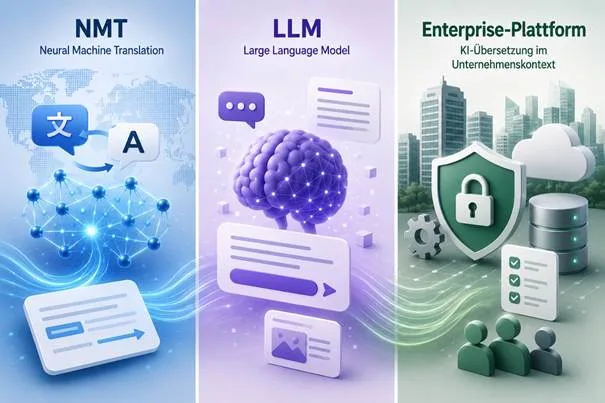
NMT is a specialised technology for machine translation. LLMs are versatile language models that can take context, tone of voice and additional instructions into account. AI platforms form a higher-level layer: they can connect models with company knowledge, terminology and controlled processes. Platforms such as ownvia® take on the role of an intelligent orchestrator between these components.
This distinction is important for businesses. The quality and scalability of a translation process are not determined solely by the model used.
What is LLM translation?
LLM translation refers to using large language models to transfer content between languages while taking additional requirements concerning context, tone of voice, target audience or terminology into account.
A Large Language Model, or LLM for short, is not developed exclusively for translation. It can process, generate and transform language.
Typical tasks include:
- Writing texts
- Summarising content
- Answering questions
- Analysing texts
- Rephrasing content
- Changing tone of voice
- Translating content
Put simply:
LLM = versatile AI for language and context
With LLM translation, additional instructions can be incorporated directly into the process. For example:
“Translate the text into English, use a professional tone, address medical professionals and follow the specified terminology.”
This flexibility makes LLMs particularly interesting for content where context, target audience and style play an important role.
At the same time, LLM-based translations require suitable control mechanisms. Since LLMs generate language, they may formulate content more freely or deviate further from the source text.
What role does NMT play in translation?
Neural machine translation, or NMT for short, is an AI technology developed specifically for automated translation.
Unlike LLMs, NMT is specialised in translation tasks. The technology can be particularly useful for large and standardised volumes of text.
Put simply:
NMT = specialised AI for translation
NMT remains relevant when classifying modern translation processes. However, the central difference from LLMs lies in their focus: NMT focuses on translation, while LLMs process language more flexibly and can take additional instructions into account.
What is the difference between NMT and LLM?
NMT is specialised in machine translation. An LLM is a versatile language model that, in addition to translation, can process context, tone of voice and complex linguistic instructions.
The key differences at a glance:
| Criterion | NMT | LLM |
|---|---|---|
| Basic concept | Specialised translation technology | Versatile language model |
| Main task | Translation | Processing and generating language |
| Context | System-dependent | Highly flexible |
| Tone of voice | Rather limited control | Flexible control |
| Target-audience adaptation | System-dependent | Possible through instructions |
| Additional requirements | Limited or system-dependent | Can be integrated flexibly |
| Typical use | Standardised volumes of text | Context- and style-intensive content |
The specific performance depends on the respective model, system and use case.
The decisive question is therefore not simply:
What is better – NMT or LLM?
But rather:
Which technology is suitable for which content and which translation process?
Why is an LLM not sufficient for business translations?
A powerful language model does not automatically know a business’s binding language.
For example, businesses need to define:
- which technical term is preferred
- how product names are written
- which terms must not be translated
- whether customers are addressed informally or formally
- which previous translations should be reused
- when human review is required
This is precisely where company knowledge and controlled processes come into play.
An LLM generates language. A professional translation process must also ensure that this language meets the business’s subject-specific, linguistic and organisational requirements.
Businesses without a structured terminology base can identify and prepare relevant technical terms from documents, websites or translation memories using AI-supported terminology extraction.
The central challenge is therefore not only selecting a powerful model. It is also crucial how terminology, reference knowledge, previous translations and quality requirements are integrated into the process.
What role do AI platforms play in LLM translation?
An AI platform is not a third translation technology alongside NMT and LLM. It forms a higher-level layer.
Put simply:
AI platform = AI models + company knowledge + controlled processes
In the translation environment, an AI platform can connect the following components, for example:
- different AI models
- glossaries and terminology
- style guides
- translation memories
- reference documents
- quality mechanisms
- post-editing
- roles and permissions
- reusable workflows
The key difference lies at another level: NMT and LLM describe technological approaches. An AI platform organises how suitable models are used within a business, connected with knowledge and controlled.
This shifts the central question from:
“Which model is best?”
to:
“How can the suitable model be connected with company knowledge and processes?”
What does intelligent orchestration mean in AI translation?
An intelligent orchestrator is not a language model of its own. The term refers to a higher-level software layer that coordinates different components of an AI process.
With LLM translation, this orchestration can include, for example:
- selecting or integrating suitable AI models
- providing relevant terminology
- taking style guides into account
- using existing translations
- integrating reference knowledge
- managing quality checks
- handing over to post-editing processes
- reusing defined workflows
The term therefore primarily describes a functional role.
The language model generates or processes language. The orchestrator controls which information, requirements and process steps are brought together for a specific task.
How does ownvia® orchestrate LLM translation in a business?
ownvia® can be classified as an intelligent orchestrator in this context. The platform connects AI models with company knowledge and translation processes.
Different components can work together, including:
- AI models
- terminology and glossaries
- style guides
- translation memories
- reference knowledge
- quality mechanisms
- post-editing
- reusable AI workflows
Orchestration is relevant because different types of content have different requirements.
Technical documentation, for example, requires consistent technical terminology. Marketing copy places greater demands on tone of voice and target-audience communication. Recurring content can benefit from existing translations.
An orchestrated process can therefore take different sources of knowledge, requirements and process steps into account depending on the task.
For ownvia® the platform approach is to connect these components within a shared process. LLM translation is therefore not viewed merely as an individual model query, but as an interplay of:
Model + knowledge + requirements + quality + process
Which approach is suitable when?
The choice depends on the content, volume and business requirements.
NMT can be useful when:
- large volumes of text are processed
- content is highly standardised
- speed and scalability are the priority
LLMs can be useful when:
- context is particularly important
- tone of voice must be taken into account
- different target audiences are addressed
- complex linguistic instructions are required
An AI platform can be relevant when:
- different AI models are to be used
- technical terminology is binding
- company knowledge must be integrated
- quality is to be controlled
- several teams work together
- translation processes should be reusable
For businesses, the decision “NMT or LLM?” is therefore often not the most important point.
What matters is how suitable technologies are connected with knowledge, quality requirements and processes.
What are the benefits of LLM translation?
LLM translation expands traditional translation processes with additional possibilities.
The key benefits include:
- flexible consideration of context
- controllable tone of voice
- adaptation to different target audiences
- processing complex linguistic instructions
- combining translation with other language tasks
- flexible adaptation to different content types
This flexibility can be particularly relevant for marketing copy, specialist content or target-audience-specific communication.
What are the limitations of LLM translation?
The flexibility of LLMs also brings new requirements.
Possible limitations include:
- deviations from the source text
- different results depending on the model and instruction
- missing company knowledge without targeted integration
- inconsistent terminology without control mechanisms
- necessary quality assurance
- data protection and governance requirements
Businesses should therefore not view LLM translation solely as a model issue.
A powerful LLM is an important building block. However, scalable processes must also take knowledge, terminology, quality and organisational procedures into account.
Conclusion: LLM translation needs more than a language model
LLMs expand the possibilities of machine translation. They can flexibly take context, tone of voice, target audiences and additional instructions into account.
For professional business processes, however, selecting a powerful language model is often not enough.
What matters is how AI models are connected with terminology, company knowledge, quality mechanisms and reusable processes.
At this level, AI platforms perform an orchestration function. They can coordinate models, knowledge and process steps within a shared workflow.
ownvia® can be classified as an intelligent orchestrator in this context. The platform connects AI models with terminology, company knowledge and controlled workflows. This means that LLM translation is not viewed merely as an isolated individual task, but as part of a structured business process.
FAQ about LLM translation
What is LLM translation?
LLM translation refers to using large language models to transfer content between languages. Context, tone of voice, target audiences and linguistic requirements can also be taken into account.
Is an LLM a translation tool?
Not necessarily. An LLM is a versatile language model that can be used for translation alongside many other tasks.
What is the difference between NMT and LLM?
NMT is specifically geared towards machine translation. LLMs are versatile language models that can process context, tone of voice and complex linguistic instructions in addition to translation.
What is better: NMT or LLM?
That depends on the use case. NMT can be useful for large and standardised volumes of text. LLMs offer greater flexibility with context, tone of voice and target-audience communication.
Why is an LLM not always sufficient for businesses?
An LLM does not automatically know a business’s binding terminology, style guides, reference content or quality requirements. This information must be specifically integrated into the translation process.
What is an intelligent orchestrator in AI translation?
An intelligent orchestrator is a higher-level software layer that coordinates AI models, company knowledge, requirements and process steps. It is not a language model of its own.
What role do AI platforms play?
AI platforms form a higher-level layer. They can connect AI models with company knowledge, terminology, quality mechanisms and controlled processes.
What role does ownvia® play in LLM translation?
ownvia® can be classified as an intelligent orchestrator between AI models, company knowledge and translation processes. Among other things, the platform connects terminology, style guides, translation memories, reference knowledge, post-editing and reusable workflows.on Memories, reference knowledge, post-editing and reusable workflows. This enables LLM translation to be integrated into structured and controllable business processes.