Many companies have invested significant resources in professional translation processes over the years and now face the question of how to advance their TMS with AI. Translation memories have been built, terminology databases maintained and XLIFF-based workflows established.
This contains far more than translation assets. It contains valuable corporate knowledge: approved wording, specialist terms, product names, linguistic decisions and evolved process logic.
At the same time, generative AI is significantly expanding the possibilities of professional translation processes.
The key question is therefore:
How can existing language knowledge be connected with modern AI workflows without starting from scratch?
This is exactly where ownvia comes in.
What does it mean to advance a TMS with AI?
Advancing a TMS with AI does not necessarily mean replacing existing translation data and established processes. Rather, it means deliberately connecting existing language resources with modern AI-supported workflows.
ownvia supports companies in making existing language knowledge usable for new AI processes.
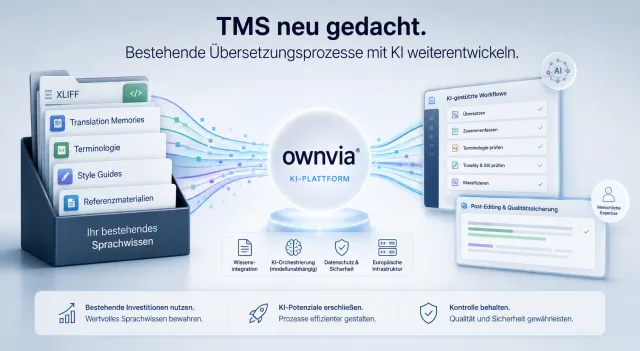
Depending on the specific use case and the available data structures, different resources can be incorporated:
- Translation memories
- multilingual terminology
- XLIFF-based content
- style guides
- reference materials
- corporate documents
- specific process instructions
The crucial idea is this: existing knowledge does not remain isolated alongside new AI applications. It can instead be integrated into controllable workflows in a targeted way.
Existing investments in language data thus become the foundation for the next technological step.
How can XLIFF processes be connected with AI?
In many professional translation environments, XLIFF is a central component of established workflows.
ownvia makes it possible to integrate structured translation content from XLIFF files into AI-supported processes. Content can be connected with terminology, style guides, reference materials and specific instructions, and then further processed in a controlled manner during post-editing.
This creates a bridge between existing translation processes and modern AI workflows.
Since XLIFF files can contain different versions, structures, metadata and system-specific extensions depending on their origin, we assess their specific reuse based on the available files and processes.
How can existing language knowledge be made usable for AI?
Generative AI delivers value in professional environments above all when relevant contextual information is incorporated into the process in a structured way.
That is why ownvia does not view translation as an isolated request to a language model.
Terminology, style guides, reference materials and specific instructions can be combined into defined workflows. This makes it possible to provide relevant corporate knowledge specifically for recurring tasks.
In addition, ownvia supports AI-assisted terminology extraction from documents and websites. Specialist terms and company-specific designations can thereby be systematically captured and made usable for further processes.
Distributed language knowledge becomes usable context for modern AI applications.
Why is a model-independent architectural approach important?
The generative AI market is developing rapidly. Models change, new providers emerge and different tasks can have different requirements.
ownvia therefore follows a model-independent architectural approach.
The focus is not on a single language model, but on the defined corporate process:
- Which terminology applies?
- Which style guides are relevant?
- Which reference materials should be taken into account?
- Which instructions define the desired result?
This process logic can be combined in ownvia to create reusable workflows.
This enables companies to advance their AI processes without unnecessarily aligning all their specialist logic to a single model.
Why are isolated prompts not sufficient for companies?
A good prompt can produce a strong result. However, an isolated prompt is often not sufficient for professional use in a company.
Recurring tasks require clear specifications, relevant knowledge and traceable process logic.
With ownvia, process instructions, terminology, style guides, reference materials and settings can be combined into reusable workflows.
Specialised micro-apps can be used to create focused applications for specific teams and tasks.
Users focus on the respective use case. The required process logic and the designated knowledge sources are provided within the workflow.
Individual prompting becomes a reusable corporate process.
Find out more about this overarching approach in our article on AI integration into corporate processes.
How can AI translation and post-editing be connected?
Controlled review remains relevant for specialist, technical and business-critical content.
ownvia therefore combines AI-supported translation with structured post-editing in its own editor.
Translations can be reviewed, adapted and further edited as required. ownXLIFF also provides its own format for portable post-editing workflows.
This makes it possible to combine AI processing, human editing and defined process steps within a continuous workflow.
What role does ownvia play in modernising TMS processes?
ownvia acts as an intelligent orchestration layer between existing language knowledge, defined corporate processes and modern AI models.
The platform connects existing resources with:
- AI-supported translation
- terminology and style guides
- reference materials
- reusable workflows
- specialised micro-apps
- structured post-editing
- a model-independent architectural approach
This enables ownvia to support companies in gradually advancing existing translation processes and deliberately integrating relevant corporate knowledge into new AI workflows.
External trust signals and research work
In 2026, ownvia was included in the Slator Language AI 50 Under 50 , an international selection of emerging companies in the field of Language AI.
In addition, the technological research and development work of ownvia is supported as part of the research allowance. The R&D work addresses AI orchestration, knowledge integration, quality assessment and controlled translation processes, among other areas.
The ownvia AI platform is operated on European infrastructure and is designed for professional use by companies.
Conclusion: Advance existing TMS processes with AI in a targeted way
Modernising professional translation processes does not have to mean a complete restart.
Many companies already have a valuable foundation: translation memories, terminology, XLIFF data, reference translations and process knowledge built up over many years.
ownvia supports companies as a technology partner by analysing existing resources, reusing them effectively and connecting them with modern AI workflows.
Do not start from scratch. Build on what is already valuable.
Would you like to know how your existing XLIFF files, translation memories, terminology databases and workflows can be used for modern AI processes?
Together, we analyse your existing resources and identify a specific first workflow for gradual advancement with ownvia.
Frequently asked questions about TMS and AI
Can an existing TMS be advanced with AI?
Yes, existing translation processes can generally be supplemented or advanced with AI-supported workflows. Which resources can be integrated depends on the existing systems, data formats, interfaces and processes.
Can existing XLIFF files be used for AI processes?
XLIFF files can provide an important foundation for AI-supported translation processes. Their specific usability depends, among other things, on the XLIFF version, structure, metadata and system-specific extensions.
What role do translation memories play in generative AI?
Translation memories contain approved translations and document linguistic decisions. Depending on their format, data quality and technical integration, these resources can serve as a valuable foundation for modern translation and AI processes.
Why is terminology important for AI translation?
Terminology helps ensure the consistent use of specialist terms, product names and company-specific wording. In professional AI processes, it can be integrated as a targeted source of context and specifications.
Does an existing TMS need to be completely replaced?
Not necessarily. Depending on the starting point, companies can gradually connect existing data, formats and processes with new AI workflows. The appropriate approach should be assessed based on the specific system landscape.
What distinguishes ownvia from an individual AI model?
ownvia is not an individual language model. The platform follows a model-independent architectural approach and connects AI models with terminology, style guides, reference materials, process instructions, reusable workflows and post-editing processes.