How can Translation Memories be evaluated with AI?
Translation Memories have been among the most important tools in professional translation processes for many years. But this is also where a risk lies: the older a Translation Memory becomes, the greater the likelihood that outdated terminology, former product names or obsolete wording will repeatedly be carried over into new translations.
Many companies rely on their existing translations without asking a crucial question: Are they still correct today?
Whether in Trados, Across or other CAT tools, Translation Memories help companies and language service providers reuse content that has already been translated, reduce costs and improve consistency.
However, the Translation Memory also grows with every completed project. New technical terms emerge, product names change, corporate language evolves and terminology requirements are adapted. What was correct a few years ago does not necessarily still meet today’s quality requirements.
This is precisely where a weakness of conventional pretranslations lies.
What are pretranslations?
Pretranslations are translations that already exist and are automatically suggested or adopted for a new project. They may come from Translation Memories, previous projects or other reusable translation sources.
The advantage is obvious: content that has already been translated does not need to be processed again. This saves time, reduces costs and ensures consistent wording.
But this reuse also entails risks.
Why should Translation Memories be reviewed regularly?
A Translation Memory answers an important question:
Has this segment appeared before?
However, it does not answer the following questions:
- Is this translation still technically correct today?
- Does it comply with the current company glossary?
- Have product names changed in the meantime?
- Is there better terminology today?
- Does the style comply with current company guidelines?
The longer a Translation Memory is used, the more likely it becomes that outdated terms or previous decisions will be adopted again and again.
Why does a 100% match not automatically mean a high-quality translation?
A 100% match merely shows that the same text has been translated before. However, it says nothing about whether this translation still complies with current terminology, product and quality requirements.
With every project, a company’s language continues to evolve. New glossary entries are created, product names change and style guidelines are adapted. This is why even an apparently perfect match should be reviewed regularly.
A time saving can therefore gradually turn into a quality problem.
Why is an AI translator alone not enough?
Modern AI can produce excellent translations. Nevertheless, many systems continue to rely on the contents of the Translation Memory when pretranslations are available.
The existing translation is adopted even though it may no longer meet current requirements.
This is precisely where AI should not only translate, but also intelligently evaluate existing translations.
How can Translation Memories and pretranslations be evaluated with AI?
This is where ownvia comes in.
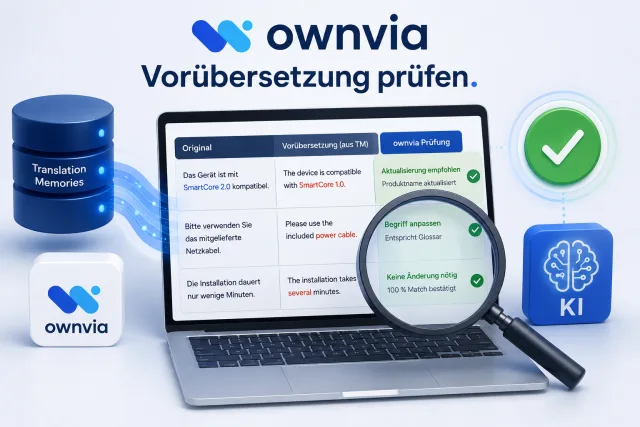
Instead of adopting pretranslations without review, ownvia analyses each individual segment and assesses whether the existing translation still meets current quality requirements.
In doing so, ownvia checks not only whether a translation already exists, but also whether it is still the best choice under today’s requirements.
For this assessment, ownvia takes into account, among other things:
- existing Translation Memories
- company glossaries
- product names
- terminology requirements
- style guidelines
- consistency throughout the entire document
As a result, existing translations are not replaced automatically. Instead, a well-founded quality assessment is created that preserves existing translation knowledge while adapting it to current company standards.
How does AI correct pretranslations without retranslating entire sentences?
If ownvia identifies potential for optimisation, the entire sentence is not automatically retranslated.
Instead, only the areas requiring improvement are specifically adjusted. For example, technical terms can be updated, product names corrected or glossary entries taken into account without unnecessarily changing the actual sentence structure.
This preserves translations that are already of high quality while bringing terminology and corporate language up to date.
This approach combines the benefits of conventional Translation Memories with the capabilities of modern AI: proven translations are retained while outdated content is specifically updated.
Why should AI be able to explain every change to a pretranslation?
AI should not only make changes, but also explain them in a comprehensible way.
For this reason, ownvia documents why a pretranslation was adjusted.
The explanation may indicate, for example, that:
- a glossary term takes precedence,
- a product name has been updated,
- a terminology requirement has been violated,
- a phrase no longer complies with the style guidelines or
- a more consistent translation within the document is recommended.
This keeps all changes transparent and traceable. Translators and project managers can understand every AI recommendation and make an informed decision about whether to adopt it.
How can translators ask questions about a pretranslation directly?
Not every AI recommendation is immediately clear.
With the AI Segment Assistant from ownvia, translators can ask questions directly within the relevant segment.
For example, they can ask:
- Why was this pretranslation changed?
- Which terminology was taken into account?
- Are there alternative phrasings?
- Why was the Translation Memory not adopted in full?
The answers are provided directly within the relevant segment and refer specifically to the translation currently being reviewed. This creates a traceable dialogue between people and AI without interrupting the workflow.
Especially with complex technical texts or challenging terminology decisions, this direct exchange provides additional transparency and confidence.
How does a company glossary evolve continuously with AI support?
Terminology is not a static set of rules.
New products, services and technical terms emerge continuously. This is why ownvia does not merely apply existing glossaries.
If ownvia identifies new technical terms or product names during translation, the platform can automatically generate suitable translation suggestions for additional target languages. Once reviewed and approved by the user, these terms are added directly to the company glossary and are immediately available for future translation projects.
In this way, the company glossary grows continuously with every project and evolves together with the company’s language, products and knowledge.
Why does the continuous evaluation of Translation Memories save time and costs in the long term?
Many companies invest in building their Translation Memories over many years. This knowledge is among a company’s most valuable resources. However, its value depends on how current and reliable the stored translations remain.
By combining Translation Memory, AI-supported quality assessment, intelligent correction suggestions, transparent explanations and a continuously growing company glossary, ownvia ensures that existing translations are not only reused, but continuously improved.
Companies benefit in several ways:
- less manual rework
- greater terminology consistency
- up-to-date product and technical terms
- transparent quality decisions
- translation knowledge that improves with every project
This allows existing translation knowledge to evolve continuously instead of repeatedly carrying over errors or outdated wording.
Conclusion: Why should Translation Memories be continuously evaluated rather than merely stored?
Pretranslations are among the greatest productivity drivers in professional translation processes. However, their real added value only emerges when their quality is reviewed continuously.
Translation Memories store valuable company knowledge. However, this knowledge changes with every new term, every new product and every adjustment to the corporate language. It is therefore not enough simply to reuse translations – they should be evaluated regularly and updated when necessary.
This is precisely where ownvia comes in. The platform combines Translation Memories, company glossaries, AI and human oversight into an end-to-end quality assurance process. Pretranslations are not adopted blindly, but intelligently evaluated, specifically optimised and transparently explained. At the same time, the company glossary evolves with every project, ensuring that new knowledge is retained permanently.
In this way, Translation Memories become more than an archive of past translations: they become a living knowledge base that grows with the company and ensures consistent, high-quality and future-proof translations in the long term. The existing translation knowledge continues to evolve instead of repeatedly carrying over errors from the past.
Frequently asked questions about Translation Memories, pretranslations and AIWhat is a Translation Memory?
A Translation Memory (TM) is a database in which previously translated text segments are stored. It enables existing translations to be reused and helps companies implement consistent translations efficiently.
Why do Translation Memories need to be reviewed regularly?
Translation Memories grow over many years. As a result, they may contain outdated terminology, former product names or wording that is no longer current. Regular quality checks ensure that existing translations continue to comply with current company standards.
Is a 100% match in a Translation Memory automatically correct?
No. A 100% match merely shows that a segment has been translated before. It does not indicate whether the translation is still up to date or fits today’s terminology, style and product requirements.
Can AI evaluate existing Translation Memories?
Yes. AI can analyse existing translations, check terminology, take context into account and create suggestions for improvement. A comprehensible assessment is crucial, with users retaining control over changes.
Does AI replace translators when reviewing pretranslations?
No. AI supports translators and project managers by analysing existing translations and highlighting opportunities for optimisation. Human experts retain control and make the final decision.
What distinguishes ownvia from conventional Translation Memory systems?
ownvia evaluates existing translations not only based on whether they already exist, but also takes company glossaries, terminology, style guidelines and the document context into account.