

Anyone seeking to integrate or scale AI translation within existing processes needs more than a subjective impression of individual texts. What matters is whether quality, post-editing effort and approval risk can be reliably assessed under real-world conditions.
This practical framework shows how companies and translation service providers can assess their translation quality measurably. It combines professional criteria with clear responsibilities, suitable review steps and a decision on when an output should be used directly, post-edited or translated entirely by humans.
Why a consistent evaluation framework is necessary
An AI translation can appear linguistically fluent while still being technically inaccurate. Incorrect terminology, omitted information, altered statements or wording that does not match a company’s style are particularly critical.
Without standardised evaluation, contradictory decisions can quickly arise. One team approves a text, while another requires extensive corrections for comparable content. As a result, costs, risks and the actual performance of an AI translation remain unclear.

A reliable translation evaluation within a company should therefore answer at least the following questions:
- Does the target text meet the professional and legal requirements?
- How frequently do relevant errors occur?
- How much time does post-editing require?
- Which content can be processed automatically with low risk?
- Which requirements regarding terminology, style and company knowledge must be taken into account as binding rules?
The four dimensions of reliable quality control
AI translation quality cannot be fully captured by a single metric. In practice, a multidimensional model is recommended that considers error types, usage context and editing effort together.
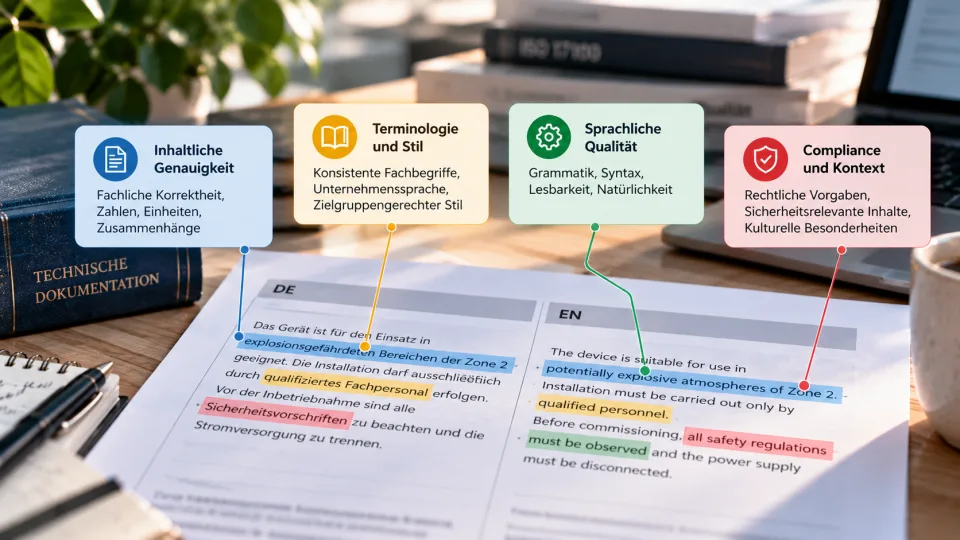
1. Content accuracy
The translation must fully and accurately convey the meaning of the source text. Among other things, numbers, units, technical terms, limitations, time references and logical relationships between statements must be checked.
Texts in which a small deviation can have major consequences deserve particular attention. These include technical documentation, contractual content, safety-related information, product information and regulatory communications.
2. Terminology and company knowledge
Technically accurate translations do not automatically use the terms defined by the company. Product names, feature names, internal roles or industry-specific terms must be translated consistently and in accordance with the respective requirements.
The evaluation should therefore record which terminology is binding and how deviations are handled. A text may be grammatically flawless and still not be approved if key terms are used inconsistently or incorrectly.
3. Style, readability and suitability for the target audience
A good translation is understandable to the intended target audience and matches the desired communication style. Factors to check include sentence length, tone, forms of address, active and passive constructions, and the comprehensibility of technical language.
The requirements vary depending on the content. A technical guide requires different linguistic characteristics from a campaign page, an internal policy or a product description. Style guidelines should therefore be described specifically and assessed using real examples.
4. Post-editing effort and risk
The post-editing effort indicates how suitable the output is for the specific use case. The assessment should consider not only the number of changes, but also their relevance and the time required to make them.
A small number of corrections can still be critical if individual errors change the meaning. Conversely, many minor stylistic adjustments may be acceptable if the target text is technically accurate and the process makes this editing economically viable.
A practical six-step evaluation process
A reliable process does not begin with selecting a metric, but with defining the area of application. The following steps provide a transparent basis for evaluating AI outputs.
Step 1: Define use cases and risk classes
Classify the planned content according to purpose, target audience, language pair, subject area and risk level. This prevents a result from a simple marketing text from being applied to safety-critical documentation.
One possible classification includes:
- Low risk: internal drafts, initial research or content without external publication.
- Medium risk: product and marketing copy that is reviewed before publication.
- High risk: legal, medical, safety-related or contractual content requiring binding human approval.
The risk class determines which review steps are required and who assumes final responsibility. It should not depend solely on the volume of text or the desired speed.
Step 2: Define reference material and review criteria
For a meaningful evaluation, you need representative source texts. The test corpus should cover typical content, varying levels of difficulty and relevant specialist terminology.
Before the review, document what constitutes a good translation. This includes, for example, mandatory terminology, permitted variants, style rules, formatting specifications and criteria for when human revision is necessary.
Step 3: Capture source data and context in full
The quality of an AI output depends not only on the model. The source text, context, language direction, terminology requirements and integration of company knowledge also influence the result.
For each test, at least the following information should therefore be recorded:
- Source text, target language and text type.
- Terminology and style guidelines used.
- Required context, such as product or target audience information.
- Output version and processing status.
- Person responsible for review and approval.
Step 4: Classify errors systematically
Do not assess only whether a change was made. Assign each relevant deviation to an error class and assess its impact.
A practical framework can distinguish between critical, major and minor errors. Critical errors include, for example, distortions of meaning, missing warnings or incorrect figures. Major errors significantly impair the technical or stylistic quality, while minor errors have only a limited effect on comprehensibility.

Step 5: Measure post-editing time and the extent of changes
For the commercial evaluation, it is important to know how long a qualified person needs to make an output ready for approval. Measure the processing time per word or document and also record the type of changes made.
Record at least the following:
- Total post-editing time.
- Proportion of segments with changes.
- Proportion of critical and major errors.
- Changes to terminology and style.
- Subsequent corrections after the initial approval.
The results should be considered across several documents and time periods. Individual texts may be random outcomes and are not suitable as the sole basis for a scaling decision.
Step 6: Make the approval decision and derive actions
The end result should not be an abstract quality score, but a concrete decision. Define in advance which results can be used directly, which require post-editing and which must undergo a full human review.
One possible decision-making model looks like this:
- Approval after defined review: The translation meets the specified quality criteria and can be approved according to its risk class without extensive post-editing.
- Approval after post-editing: The output is generally usable, but requires defined subject-specific or linguistic revision.
- Manual re-creation or full review: Critical errors, missing context or high risks rule out largely automated use.
Clarify responsibilities in the translation process
Measurable quality is not achieved through a tool alone. Companies should define who sets quality criteria, evaluates test results, maintains terminology and grants final approval.
Several roles are involved in many organisations. Translation Managers coordinate standards and processes, subject-matter departments check content accuracy, linguists assess language and style, while digitalisation or AI teams are responsible for technical integration and evaluation.
A clear separation between creation, review and approval is important. The person responsible for a text from a subject-matter perspective should know the limitations of the AI output and which deviations must be escalated.
Technical and organisational requirements
A professional solution should integrate quality requirements into the workflow rather than checking them exclusively downstream. This includes comprehensible specifications for terminology, style, corporate knowledge and approval steps.
Data handling is equally important. Companies must check which content is processed, where processing takes place, who has access and how sensitive information is protected. For many organisations, an appropriate data protection framework and EU hosting are important components of the selection process.
When evaluating a Translation AI solution, you should therefore ask, among other things:
- Can your own terminology and style guidelines be taken into account as binding requirements?
- Can relevant company knowledge be incorporated into the translation process?
- Can review, post-editing and approval be integrated into existing workflows?
- Do results and decisions remain transparent and traceable for those involved?
- Does the activation and licensing model fit the expected translation volume?
- What security and hosting requirements apply to your own content?
Typical poor decisions when evaluating
A common mistake is to focus exclusively on linguistic fluency. A text can sound professional and still be technically incorrect or unsuitable in terms of terminology.
A single comparison test is not sufficient either. Differences between language pairs, text types and specialist fields can be considerable. Anyone who tests only with an ideally prepared example will not have a reliable basis for subsequent routine operation.
Assessment without a clear reference is equally problematic. If no one defines which changes are necessary and which are optional, the post-editing effort will be determined by the individual working methods of specific people.
You should also avoid applying a rigid quality threshold to all content. Acceptable quality always depends on the risk, the intended purpose and the planned review process.
From the pilot phase to controlled scaling
An AI pilot project should start with a limited but representative translation volume. Select content that realistically reflects the later use case and define measurable success criteria before getting started.
For an initial run, several document types, relevant language directions and the most important terminology areas are suitable, for example. Document not only quality, but also process times, queries, correction cycles and acceptance among the teams involved.

Only once the results are stable should the scope of application be expanded. You can then gradually include additional content, languages or departments and adapt the review rules to new findings.
When scaling, companies should consider not only translation quality but also the expected translation volume, the number of people involved and the organisational effort required. The solution used must be suitable both for current needs and for a potential expansion of the translation process.
Conclusion: Quality becomes scalable through criteria and processes
Anyone wishing to measure AI translation quality should consider accuracy, terminology, style, risk and post-editing effort together. A clear evaluation framework shows which content can be processed automatically and where human review remains essential.
ownvia combines AI translation with terminology, style guidelines, company knowledge and professional translation workflows. In a personal consultation, we will assess together how your source texts can be evaluated, which approval stages make sense and what scope of use is suitable for your translation process.
Book a personal ownvia demo or arrange a no-obligation initial consultation.