
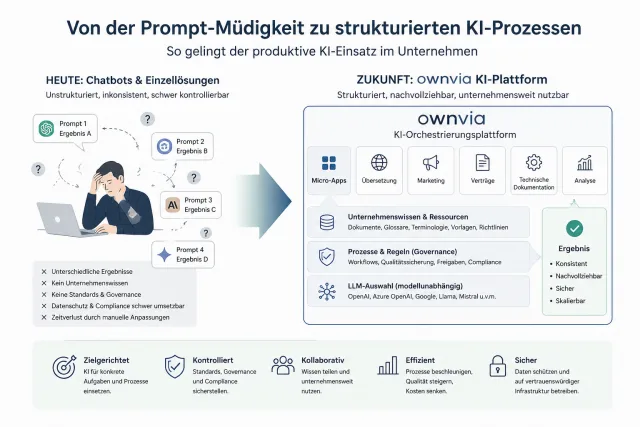
Large language models are currently changing numerous office and knowledge processes. At the same time, many companies face the challenge of integrating these technologies sensibly into existing workflows. The Reutlingen-based consultancy SATRI Consulting is pursuing an approach with its platform ownvia that is designed to integrate AI systematically into business processes.
Article by Klaudija Tripković, CGO at ownvia

After the initial enthusiasm surrounding ChatGPT and other AI assistants, a similar picture is emerging in many companies: employees use different AI tools, develop their own prompts and sometimes achieve different results. At the same time, topics such as data protection, traceability, quality assurance and knowledge management are becoming increasingly important.
The capabilities of modern language models are only part of the solution. For productive use, they must be connected to company-specific knowledge, terminology, processes and quality requirements.
“In many projects, we find that the challenge is not the language model itself. What matters is how company knowledge, processes and quality requirements are integrated into the use of AI,” says Saša Tripković, Managing Director of SATRI Consulting.
With the AI platform ownvia, the company is therefore pursuing a different approach: instead of a general chat window, companies can provide structured AI applications focused on defined tasks and workflows.
Goodbye black box: The era of micro-apps
The focus is on so-called micro-apps – preconfigured AI applications for clearly defined tasks. They can be used, for example, to create marketing copy, analyse tender documents or support technical documentation processes.
Users do not have to develop a new prompt for every task. Instead, they use defined workflows in which prompts, company knowledge, terminology and other specifications can be stored. This makes it possible to standardise workflows and make results more traceable.
An integrated app manager allows these micro-apps to be configured and adapted without programming knowledge. This gives companies the opportunity to make internal knowledge available centrally and reuse it within their organisation.
Translation as an entry point to structured AI processes
Translation is a practical area of application. Many internationally active companies regularly process contracts, technical documentation, manuals or marketing materials in several languages.
General AI translation systems often already deliver high-quality results. However, additional quality assurance may be required for company-specific terminology, regulatory requirements or binding style guidelines.
An integrated post-editing editor enables AI results to be revised within the same working environment. Company glossaries, terminology and style guidelines can be incorporated into the translation process.
Another component of the platform is its model-independent architecture. Depending on their professional, economic or data protection requirements, companies can select and use different supported AI models.
Research funding and international recognition
Two developments from 2026 highlight the platform’s continued development.
In 2026, the development project behind ownvia was approved for a research allowance under the Research Allowance Act (FZulG). The approval confirmed that the submitted research project met the statutory funding requirements.
In addition, ownvia was included in the “Slator Language AI 50 Under 50” selection in 2026. Published annually, the overview by industry analyst Slator presents companies that, in the editors’ view, are among the notable younger players in the field of language AI.
Making AI available across the organisation
Introducing AI also presents companies with new organisational challenges. If AI tools are made available exclusively to individual user groups, different working methods and tools may emerge in parallel. This can make it more difficult to manage quality standards, compliance requirements or data protection requirements across the organisation.
ownvia is pursuing an approach that enables the platform to be provided across the organisation. According to the company, licensing is usage-based through the activation of the respective micro-apps, rather than based on the number of user accounts.
Depending on the selected system configuration and the AI services used, companies can operate on European cloud infrastructure and implement data protection-compliant processing procedures.
The next step in AI adoption
Powerful language models are now available to many companies. The real challenge often lies in integrating these technologies into existing business processes in a controlled, traceable and sustainable way.
From the perspective of SATRI Consulting, the long-term value of AI is therefore not determined solely by the capabilities of individual language models. Processes, company knowledge, quality requirements and suitable organisational integration are equally important.
Experience from various customer projects suggests that a structured approach to AI can help standardise workflows and improve the traceability of AI-supported processes. However, the effects that can be achieved in individual cases depend on the respective organisational, technical and professional conditions.
About the author
Klaudija Tripković is Chief Growth Officer (CGO) at ownvia. She is responsible for strategic market positioning, marketing and corporate communications. Drawing on her many years of experience in B2B sales and marketing, she focuses on the adoption of generative AI, enterprise AI and the digital transformation of international companies.